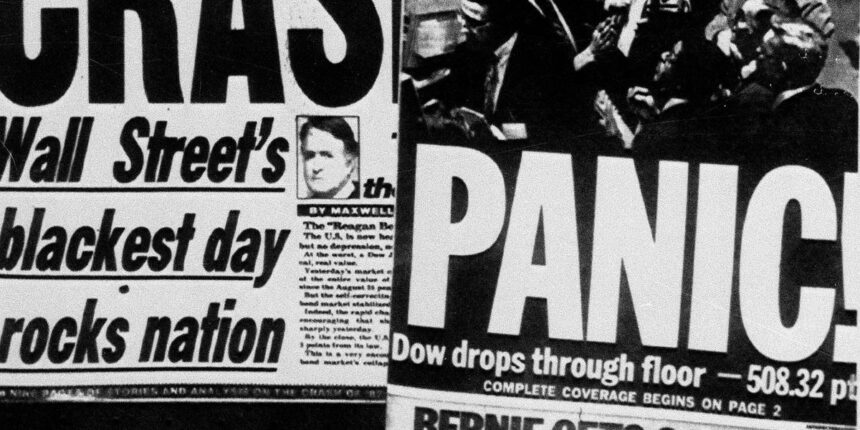
In the landscape of finance, few experiences haunt investors as profoundly as the memories of stock market crashes. William Goetzmann, a Yale economist, has witnessed four significant downturns during his investment career: 1987, 2000, 2008, and 2020. Reflecting on the 2008 crash, Goetzmann recounted a devastating loss — a 50% drop in his life savings, a sentiment echoed by many American investors at the time. This experience has shaped a pervasive sense of fear among investors, creating a constant undercurrent of anxiety about potential future crashes.
Goetzmann’s research indicates that such fears are not unfounded; surveys conducted since 2000 consistently reveal that investors perceive a 10% to 20% likelihood of a crash occurring within the next six months. Intriguingly, external factors unrelated to the stock market, such as natural disasters, can amplify this sentiment. For instance, a significant earthquake might lead individuals to believe the chance of a market downturn is heightened.
Currently, the apprehension surrounding a market bubble is palpable, exacerbated by a dramatic 86% surge in AI stocks over recent years, along with the S&P 500’s Shiller CAPE ratio soaring to its third-highest level in history. However, Goetzmann points out that this anxiety often contradicts historical data. His analysis reveals that while market crashes can occur after substantial surges, such incidents are relatively rare and tend to be short-lived.
In a study published in 2016, Goetzmann examined global market data since the 1880s, focusing on instances where markets surged by 100% over one to three years. He discovered that the probability of stocks declining by at least 50% in the subsequent year or five years was less than 1%. Remarkably, there were cases where markets rebounded, rising another 100% about 26% of the time.
Despite this optimistic data, Goetzmann acknowledges the limitations of his research. Notably, it does not consider prolonged declines like the 49% drop in the S&P 500 following the dot-com bust in 2000-2002, which left many investors nursing substantial losses for years. Furthermore, market crashes often coincide with recessions, forcing some investors to liquidate their holdings at inopportune moments due to financial pressures.
Goetzmann advocates for a long-term investment strategy. He asserts that individuals willing to stay invested for five years after a market crash are likely to emerge in a better financial position. However, he recognizes the constraints faced by some, particularly smaller college endowments that rely on steady returns to support operations.
His primary concern today is that growing fear among investors could deter them from participating in the stock market altogether. In our hyper-connected era, where alarming news is constantly accessible, this pervasive anxiety could lead to missed opportunities for growth. Goetzmann fears that many might choose to remain on the sidelines, believing that the market could crash at any moment, risking their long-term savings.
He emphasizes the importance of maintaining a steady hand during turbulent times. Throughout his own experiences with market downturns, Goetzmann retained his investments, ultimately benefiting from the subsequent bull markets that followed. The lesson he imparts is clear: by adhering to informed investment strategies and resisting the impulse to react emotionally, even during times of crisis, investors can navigate downturns with greater resilience and potentially reap longer-term rewards.