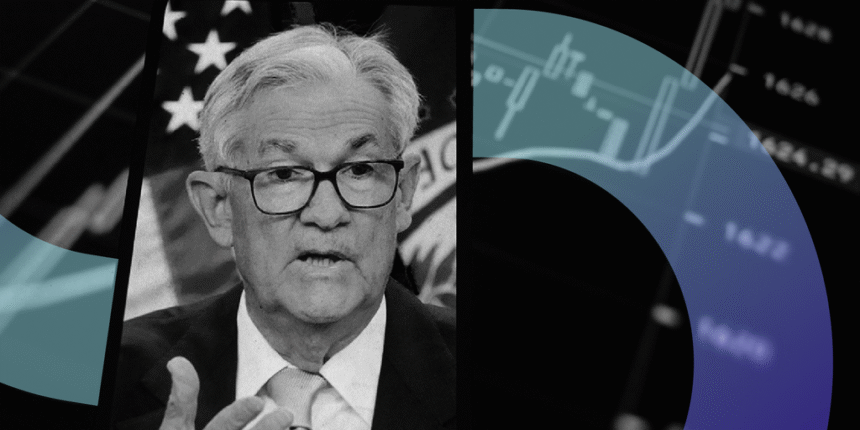
The Federal Reserve has chosen to maintain its benchmark interest rate for the third consecutive time this year, signaling a cautious approach amid escalating tensions in the Middle East that have led to rising energy prices. The decision to keep the interest rate within a target range of 3.5% to 3.75% follows what is expected to be Fed Chair Jerome Powell’s final meeting at the helm, as his eight-year term ends next month.
In a statement accompanying the decision, the Fed cited the ongoing developments in the Middle East as contributing to a significant degree of uncertainty regarding the economic outlook. Meanwhile, cryptocurrency markets reacted with Bitcoin and Ethereum trading around $75,100 and $2,240, respectively, both experiencing declines—Bitcoin down 1.4% and Ethereum falling 2.3% in the last 24 hours, according to CoinGecko.
In related developments, the Senate Banking Committee has advanced the nomination of Kevin Warsh, who is set to succeed Powell as chair. With his nomination now progressing to a full Senate vote, where Republicans maintain majority control, the timeline for a leadership transition at the Fed is becoming clearer. Should Warsh not receive confirmation by May 15, Powell has indicated that he would serve as “chair pro tempore” to assist with a smooth transition. Importantly, Powell has expressed willingness to remain a Fed governor to bolster institutional stability during this period.
The backdrop to these leadership changes includes the conclusion of a Justice Department investigation into Powell, which had been a point of contention for some, including Senator Thom Tillis (R-NC). Tillis had pledged to block Warsh’s nomination until the investigation was resolved, describing it as unfounded.
Warsh, whose net worth is estimated at $100 million, has disclosed significant investments linked to the cryptocurrency sector, including holdings in Solana and Polymarket. Although he has previously criticized various crypto projects as fraudulent, he has shown support for Bitcoin.
During the recent Federal Open Market Committee (FOMC) meeting, Fed Governor Stephen Miran called for a 25 basis-point rate cut, indicating a divided opinion within the committee, as three other members favored the current rates while refraining from suggesting an easing bias.
Lower interest rates typically benefit risk assets such as stocks and cryptocurrencies by making borrowing cheaper and enhancing liquidity. However, market participants do not anticipate any changes in monetary policy conditions in the near term, with many expecting rates to remain steady through December, according to data from CME FedWatch.
The ongoing conflict in the region has heightened energy costs, complicating the Fed’s objective to bring inflation down to its target level of 2%. The average national price of gasoline reached $4.22 per gallon on Wednesday, reflecting a 6.2% increase over the previous month, significantly higher than the $2.99 average seen prior to the eruption of hostilities between the U.S. and Iran. Ships traversing the Strait of Hormuz, a critical pathway for oil supplies accounting for 20% of global flows, continue to face challenges, further pushing up energy prices.