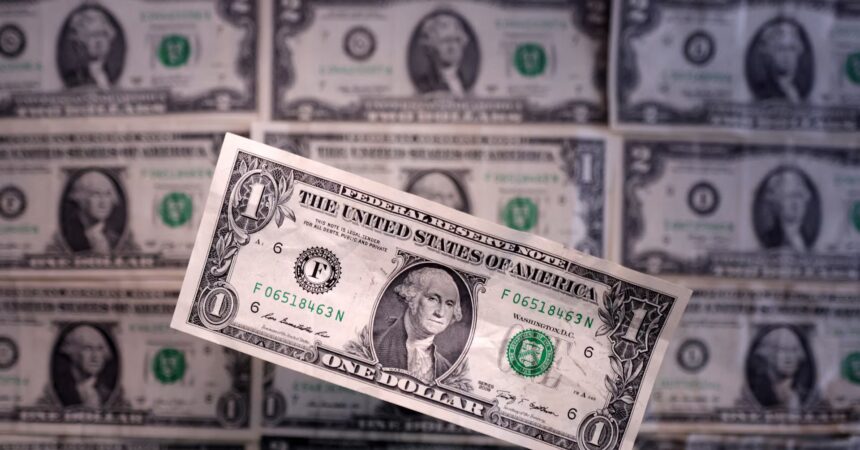
The U.S. dollar remained stable on Tuesday as traders awaited the Federal Reserve’s December minutes, which are anticipated to reveal internal divisions regarding the central bank’s policy direction for 2026. This uncertainty has left investors feeling uneasy, particularly following a challenging year for the dollar that has seen the euro and pound achieve their strongest performances since 2017.
As of the latest reports, the euro was trading at $1.1772, marking a 13.7% increase for the year, while the pound stood at $1.3504, poised for an 8% rise. A weaker dollar has also allowed the Chinese yuan to breach the critical 7 per U.S. dollar threshold, despite the People’s Bank of China attempting to manage the currency’s fluctuations through guidance rates and verbal interventions.
The dollar index, which compares the U.S. dollar against a basket of other currencies, is projected to experience a 9.6% annual decline — the steepest drop in eight years. This decline has been attributed to speculation surrounding potential Federal Reserve rate cuts, diminishing interest rate differentials, and concerns regarding fiscal deficits and political uncertainty. The index was recorded at 98.022, lingering close to a three-month low observed last week.
Investor attention is now turning to the upcoming Fed minutes after the central bank implemented rate cuts earlier this month, indicating that these rates could remain steady in the immediate future. Policymakers appear divided over the trajectory of rates moving into next year, with market participants pricing in additional cuts for 2026 — signaling potential for further dollar depreciation. Strategists at MUFG foresee a 5% decline in the dollar index next year, largely driven by the U.S. economic landscape and monetary policy directions.
In the context of the Japanese yen, recent trading showed it at 156.07 per dollar, stabilizing after hitting levels that prompted stern warnings from Japanese officials and renewed concerns about potential intervention in the currency market. Despite the Bank of Japan’s rate hike in December, the yen has remained largely unchanged against the dollar throughout the year. The central bank’s policymakers are reportedly contemplating further interest rate increases to address inflation, with some advocating for hikes every few months.
Analysts note that growth expectations may be influencing the dollar-yen exchange rate more significantly than monetary policy itself. Kit Juckes, chief FX strategist at Societe Generale, emphasized that stronger GDP growth is essential for the yen. Japan’s government recently projected a 1.1% economic expansion for the current fiscal year, an increase from earlier forecasts, with growth anticipated to further accelerate to 1.3% in the following fiscal year.
In other currency markets, the Australian dollar was recorded at $0.6693, slightly under its 14-month high, and is set for an 8% annual rise — its best performance since 2020. The New Zealand dollar is at $0.5806, projected to achieve a 3.7% gain for the year, marking the end of a four-year losing streak.