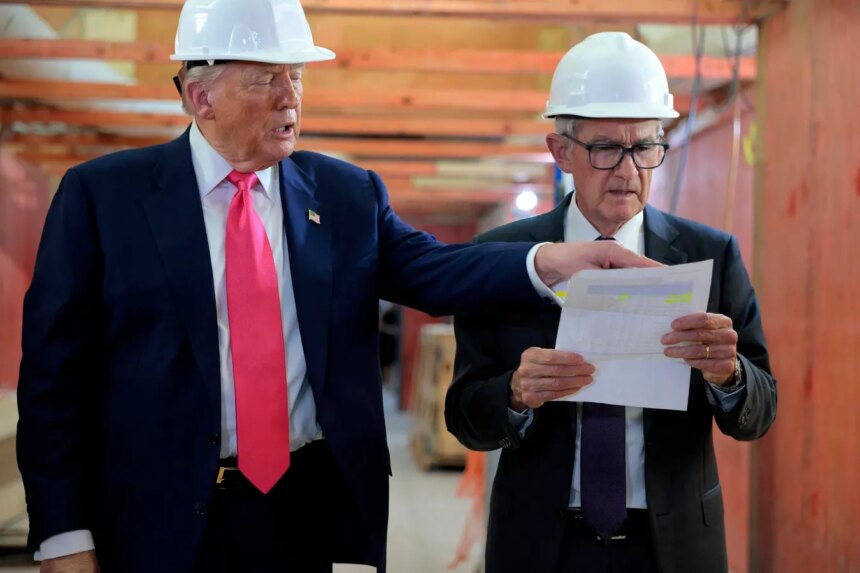
In a notable development within the financial landscape, U.S. President Donald Trump and Federal Reserve Chair Jerome Powell recently toured the Federal Reserve’s extensive $2.5 billion headquarters renovation project in Washington, D.C. This visit highlights the ongoing tensions between the Trump administration and the Federal Reserve, particularly surrounding the costs associated with the renovation and Powell’s leadership.
Amid this backdrop, the Justice Department’s criminal investigation into Powell has emerged as a significant event, positioning it as one of the most intensive challenges to the independent functioning of the central bank in the country’s modern history. The inquiry, instigated by a referral from Rep. Anna Paulina Luna, resulted in grand jury subpoenas served on January 9, implying potential criminal charges linked to Powell’s testimony regarding the renovation. U.S. Attorney Jeanine Pirro is spearheading this investigation, which has raised alarms about the implications for monetary policy independence.
Powell has publicly addressed the situation, suggesting that the legal assault is an effort to influence how the Federal Reserve manages interest rates. He insists that the institution’s decisions should be based on economic evidence and conditions, not swayed by external political pressures. The Supreme Court is set to consider Trump’s actions regarding the dismissal of Fed Governor Lisa Cook, a ruling favoring the administration could set a concerning precedent for Powell’s tenure.
In the meantime, the ongoing crisis surrounding the Federal Reserve has invigorated discussions within the cryptocurrency community. Prominent advocates are now asserting that Bitcoin could potentially reach a valuation of $1 million by 2026, a claim that echoes the sentiments expressed by industry leaders like MicroStrategy’s chairman, Michael Saylor, and BitMEX co-founder Arthur Hayes. The rationale behind this forecast is tied to the prevailing unsustainable debt levels faced by governments, which proponents argue necessitate continued monetary expansion—thus positioning Bitcoin as a viable alternative asset, given its capped supply.
Analysts backing this bullish prediction suggest that the current economic climate, marked by soaring debt and increasing inflation expectations, aligns with Bitcoin’s narrative as a form of “pristine collateral.” They note that with institutional demand driven by exchange-traded funds (ETFs), the potential for Bitcoin’s price to reach unprecedented heights becomes increasingly plausible. However, reaching $1 million would necessitate a tenfold increase from its current trading price of around $95,000, translating to a staggering market capitalization exceeding $20 trillion, more than gold’s total market value.
Skeptics of this projection caution that such astronomical claims could be overly optimistic. They highlight a potential need for significant global systemic changes that have yet to emerge. Some analysts even predict a downturn, projecting prices might fall to between $50,000 and $70,000 in a bearish market scenario.
The implications of the Federal Reserve’s struggles are crucial, as they not only impact traditional monetary policy but also resonate deeply within the cryptocurrency discourse. If political influence successfully undermines the Fed’s independence, it could further substantiate Bitcoin’s proponents’ argument regarding the inherent vulnerabilities of fiat currency systems. This scenario would underscore the notion that alternatives to state-controlled money might be essential, regardless of the outcome of Powell’s legal woes. As the situation progresses, the interconnectedness between central bank policies and the future of cryptocurrencies will be closely scrutinized, with the unfolding events potentially shaping the financial landscape for years to come.