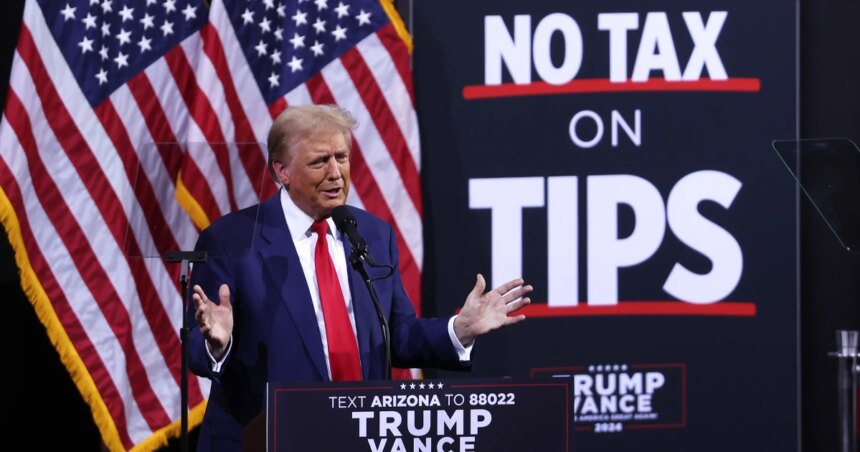
As the tax-filing deadline approaches, millions of Americans are preparing to take advantage of new federal income tax breaks related to tips and overtime wages. These changes are the result of a comprehensive tax law enacted by former President Donald Trump, offering many taxpayers potential savings. However, a significant hurdle is emerging at the state level, where many individuals may find themselves unable to claim the same deductions when filing their state income tax forms.
The crux of the issue lies in the fact that each state has the discretion to adopt or reject federal tax changes. This has led to a patchwork of tax regulations across the country, with many states opting not to align with federal provisions. Consequently, workers who receive federal deductions for tips or overtime wages in states that do not conform to these changes will still be liable for state taxes on those earnings.
The federal tax-filing deadline is set for Wednesday, and this timeline is mirrored by most states. For clarity on state income tax rates and deductions, it is important to note that 41 states levy taxes on wages and salaries. Most taxpayers must complete two separate forms: the federal income tax form followed by the state income tax form. This sequence is crucial, as states typically use figures from the federal form to calculate their own taxes.
Remarkably, there are eight states that do not impose any income tax at all: Alaska, Florida, New Hampshire, Nevada, South Dakota, Tennessee, Texas, and Wyoming. Washington state distinguishes itself by taxing capital gains rather than wages, while Missouri taxes income from wages but not capital gains.
While only a handful of states are mimicking Trump’s federal law by offering tax breaks for tips and overtime wages, there are exceptions. Idaho, Iowa, Montana, North Dakota, and Oregon have extended these tax deductions, whereas Colorado provides breaks for tips and auto loans but has opted out of the overtime deduction. Alabama offers only the auto loan deduction.
In an unusual development, Arizona’s tax forms currently list deductions for tips, overtime, and auto loans following an executive order from Democratic Governor Katie Hobbs. Despite this, the state law has not been formally updated, as Hobbs vetoed two bills that included provisions for adopting corporate tax breaks based on Trump’s legislation.
Legal experts have pointed out the peculiarities of Arizona’s situation, emphasizing that many residents may claim deductions they are not formally entitled to, as directed by the state government. There remains a possibility that Arizona could subsequently enact a law to formally authorize these deductions either before or after the upcoming tax-filing deadline.
In two additional states, efforts to implement similar tax breaks fell short. While South Carolina extended its tax refund filing deadline to October 15 to allow for potential alignment with federal tax deductions, legislation died in the Senate. Meanwhile, in Wisconsin, tax breaks for tips and overtime passed the Republican-controlled Legislature but were vetoed by Democratic Governor Tony Evers.
Residents of states like Georgia, Indiana, and Michigan can expect new tax deductions for tips and overtime wages beginning in the 2026 tax year, but these will not apply to those filing their 2025 tax returns. Meanwhile, Oregon is considering legislation that could eliminate certain tax breaks going into effect in 2026.
As this tax season unfolds, state legislatures continue to grapple with the implications of these federal changes, leaving many taxpayers in a state of uncertainty regarding their financial obligations and potential deductions.