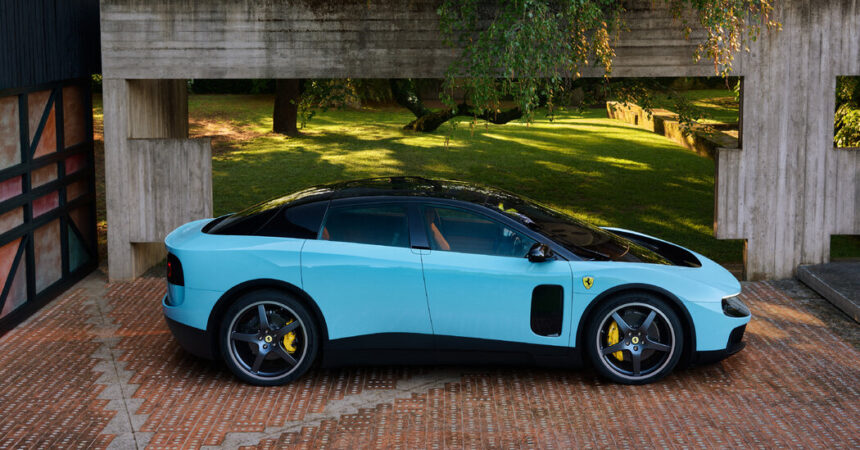
Many automakers are grappling with the challenge of convincing consumers to embrace electric vehicles (EVs), and Ferrari is no exception. The unveiling of the Luce, Ferrari’s first electric sports car, has met with significant backlash from both investors and passionate car enthusiasts. Since its introduction, the Luce has sparked controversy in Italy, resulting in a flurry of negative memes and a notable decline in Ferrari’s share price.
On Wednesday, Ferrari commenced orders for the Luce, priced at an impressive 550,000 euros, equivalent to approximately $640,000. However, the car’s flashy launch event was not enough to sustain investor confidence, as the company’s stock saw an 8 percent drop. Analysts are now pondering whether the Luce’s rocky reception foreshadows challenges for Ferrari’s broader electrification efforts.
Harald Hendrikse, an automotive analyst at Citi, expressed uncertainty regarding the impact of the Luce on Ferrari’s brand perception. He noted that high-end automakers have struggled to gain traction with electric vehicles and suggested that the timing of the Luce’s launch could accentuate these risks.
In a departure from tradition, Ferrari partnered with external design agency LoveFrom, led by Jony Ive, former head of design at Apple, for the Luce’s design. Opinions on the new aesthetic have been mixed. While some reviewers lauded its engineering, interior design, and rapid acceleration, many die-hard fans, known as Ferraristi, have expressed reservations about the car’s unconventional, bubblelike appearance. They instead cherish the sleek lines and iconic engine sounds of classic models like the Ferrari F80.
Online responses have been sharp, with the Luce often compared to the Nissan Leaf, a much less expensive electric vehicle. One Reddit user questioned, “Why is it that some automakers think that electric vehicles have to look like electronic devices?” The meme culture surrounding the Luce has also thrived, with visuals depicting the car humorously resembling an iPhone charger.
Former Ferrari chairman Luca di Montezemolo offered unflattering commentary on the car, hinting at significant reputational risks for Ferrari. He stated, “If I say what I think, I’d cause harm to Ferrari” but later added, “We’re risking the destruction of a legend.” Matteo Salvini, Italy’s Deputy Prime Minister, echoed these sentiments on social media.
Conversely, some notable figures like Pope Leo XIV and Italian President Sergio Mattarella appeared impressed during a VIP display of the Luce in Rome.
Ferrari’s chief executive, Benedetto Vigna, views the Luce as a “Leapfrog moment” for the company, which has a storied 80-year history in high-performance sports cars. Vigna has ambitious goals for Ferrari’s electric future, particularly since he assumed leadership in 2021. However, following a disappointing growth forecast in October — which included a downgrade in its electric vehicle ambitions — Ferrari’s shares have plummeted by a third, erasing nearly $30 billion from its market valuation.
The company now forecasts that only 20 percent of its 2030 model lineup will be entirely electric, down from a previously stated goal of 40 percent. The hybrid segment, however, remains steady, with plans for it to constitute 40 percent of new vehicles.
In a broader context, the market for high-end electric vehicles appears stagnant, with luxury carmakers like Mercedes-Benz, Porsche, and Lamborghini reassessing their electric strategies. Questions linger over whether Ferrari has misjudged the market’s appetite for luxury electric vehicles, especially given the robust profits derived from its gasoline-powered and hybrid models. Hendrikse concluded that these traditional offerings are likely to drive Ferrari’s profitability for the foreseeable future.