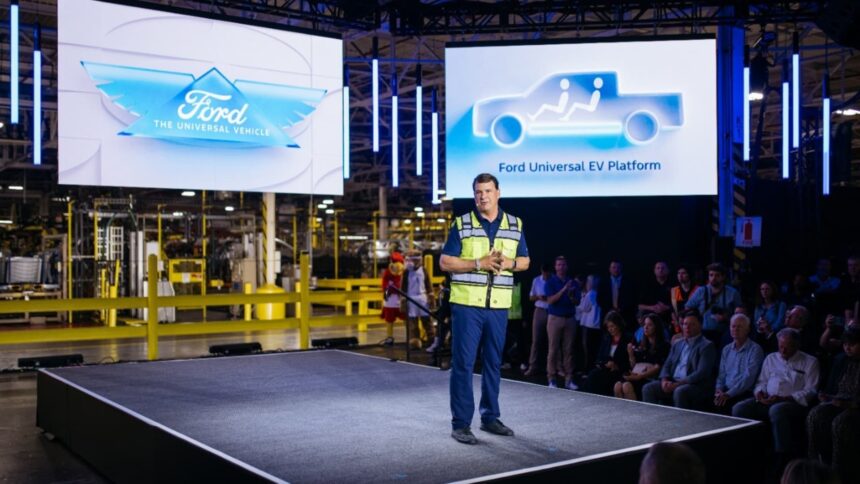
Ford Motor Company has unveiled early renderings of its next-generation electric pickup truck, a significant move that showcases the automaker’s aggressive strategy in the evolving electric vehicle (EV) market. With a hefty investment of $5 billion, Ford is betting on an advanced electrical architecture, known as a 48-volt system, which it announced will be incorporated into its upcoming EV lineup.
This 48-volt architecture, recently commercialized by Tesla with its Cybertruck, marks a substantial shift from the traditional 12-volt systems that have prevailed in the automotive industry for decades. Typically, a 12-volt system relies on lead-acid batteries to power vehicle accessories, a setup that has led to numerous recalls for many electric vehicles. The new system utilizes the electric vehicle’s high-voltage battery to run various components, improving efficiency, enhancing bandwidth capacity, and reducing weight by minimizing the amount of wiring needed.
Officials at Ford claim that this enhanced electrical architecture will pave the way for more efficient production methods and lighter vehicle designs, which are critical as the company aims to compete against Tesla and a growing number of Chinese brands in the global EV market. Ford’s CEO, Jim Farley, emphasized the bold nature of this initiative, stating that the company is prepared to confront its competition head-on, proclaiming it a “Model T moment” for Ford in an effort to revitalize its approach to vehicle manufacturing.
The forthcoming EVs, based on the Universal Electric Vehicle (UEV) platform, will notably include a small electric pickup truck priced around $30,000, set to launch in 2027. This new model aims to dissolve the cost barriers that have made EVs less accessible to consumers, as current large batteries often inflate production expenses. By reducing the number of vehicle parts by 20% and streamlining assembly processes, Ford predicts significant cost savings and easier scalability.
Despite a recent downturn in U.S. EV sales, attributed to changing federal incentives and consumer reluctance, Ford remains committed to its electric future. The automotive giant reported $19.5 billion in write-downs mostly tied to its EV strategies, yet it retains its $5 billion investment for developing the new platform through 2027. Senior executives, including Alan Clarke, Ford’s executive director of advanced EV development, expressed confidence that the new offerings will not only be affordable but also highly desirable for consumers.
In conjunction with the 48-volt system, Ford is also implementing innovative manufacturing techniques such as “gigacasting.” This approach allows for the creation of larger structural components that can replace multiple smaller parts, significantly streamlining production processes and reducing the overall weight of the vehicles. For instance, the new electric pickup will feature just two structural parts in the front and rear, as opposed to the 146 components found in its current gas-powered models.
Clarke commented on the importance of this evolution in manufacturing, asserting that continuous innovation is essential to decrease EV costs and to fulfill consumer expectations. As Ford gears up for this monumental shift in its operations, the automaker hopes to redefine its place in a rapidly changing market, leveraging these advancements to drive widespread adoption of electric vehicles.