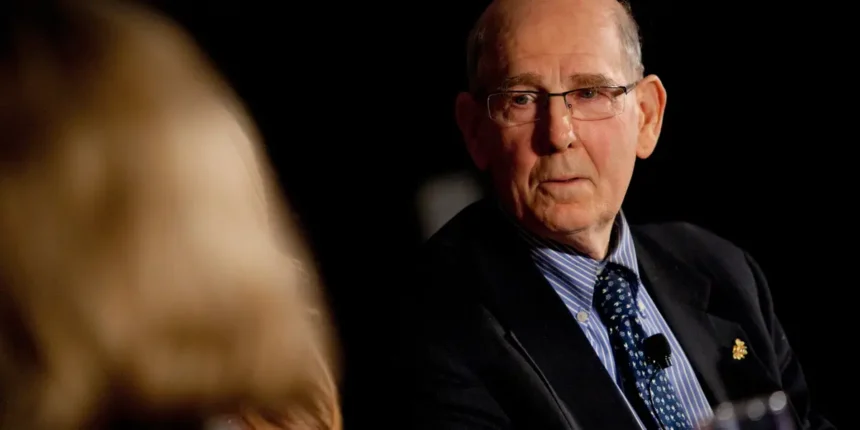
In a recent interview with Business Insider, renowned economist Gary Shilling expressed his stark concerns regarding the U.S. economy’s trajectory in the coming year, emphasizing that a recession appears imminent. Shilling, a seasoned analyst with a background at Merrill Lynch, highlighted that several indicators suggest the economy is on the brink of downturn, coupled with unsustainable levels in stock market valuations.
Shilling conveyed his belief that ongoing vulnerabilities across multiple sectors are paving the way for a recession. He projected a significant correction in the stock market, forecasting that the S&P 500 could potentially drop by as much as 30% by the end of the year. The factors that might stave off such a downturn, according to him, would be an unexpected surge in fiscal stimulus or continued robust consumer spending—both of which he deems unlikely.
A crucial area of concern is the housing market, which remains largely immobilized due to the anticipation of sustained high-interest rates. After experiencing a brief uptick in existing home sales last year coinciding with lower mortgage rates, activity has since stagnated as rates have climbed.
Moreover, Shilling pointed to a sharp decline in capital expenditures across the private sector. Although investments in artificial intelligence are thriving, overall capital expenditure growth reportedly fell to 3.9% at the end of last year—significantly lower than its peak of over 24% observed during the pandemic.
Consumer expenditure, which constitutes about two-thirds of economic growth, has historically served as a stabilizing factor for the U.S. economy. However, Shilling predicts a potential decline in consumer spending in the upcoming year, highlighting strain from inflationary pressures, particularly the recent surge in energy prices stemming from geopolitical tensions. The Bureau of Labor Statistics indicated a 12.5% year-over-year rise in energy prices, marking the most significant increase since 2022. Concurrently, real disposable income growth has decelerated to a mere 0.4% annual pace—the lowest rate in about three years—and the personal savings rate has slipped to 3.6%, its lowest since 2022. “That’s really on very thin ice in terms of income and people’s willingness to spend,” Shilling warned.
On the stock market front, Shilling underscored that valuations have reached concerning heights. He alluded to multiple metrics suggesting an overvaluation of stocks, notably the Shiller CAPE ratio—an inflation-adjusted price-to-earnings ratio for the S&P 500—which is currently at its highest since the dot-com bubble. Additionally, both the price-to-sales and price-to-book ratios for the S&P 500 also reflect all-time highs. “Stocks are very expensive, and there probably is a major correction coming somewhere in the relatively near future,” Shilling stated, indicating that he anticipates a decline may unfold by the end of 2026.
Although the specific catalyst for a market decline is uncertain, Shilling noted that historical sell-offs often stem from market excesses. While he acknowledged the ongoing AI boom, he did not identify it as a definitive sign of excess. “I’ve sort of made a career looking for those hidden flaws, and I don’t see anything right now that is just screaming for a big sell-off, but that doesn’t mean it isn’t there,” he cautioned.
Shilling’s longstanding bearish outlook has been a consistent theme over the past four years. He previously warned that a downturn could be triggered by rampant speculation in financial markets, particularly pointing to the fervor surrounding AI and cryptocurrencies. As uncertainty looms, investors are urged to proceed with caution amid these challenging economic indicators.