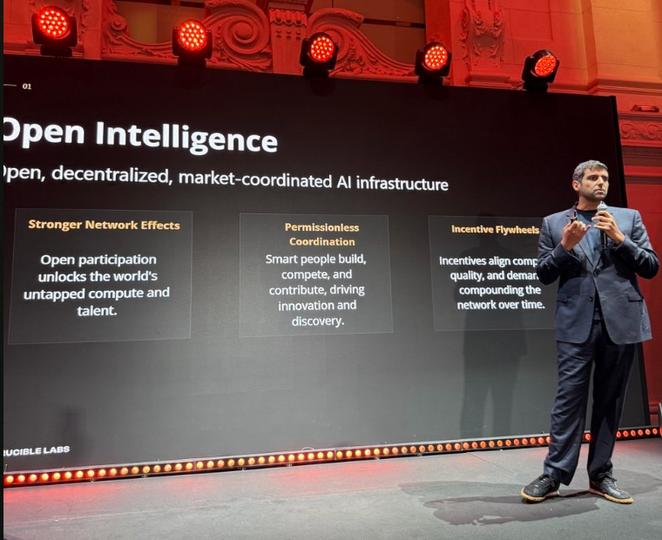
The landscape of global computing is experiencing a transformative shift from traditional, centralized corporate data centers to expansive, decentralized networks. This evolution was emphasized by Ala Shaabana, co-founder of Bittensor and partner at Crucible Labs, during his keynote address at the Proof of Talk summit in Paris. He underscored the immense potential of decentralized networks by demonstrating how they significantly outstrip conventional enterprise systems in terms of computing power.
In an eye-opening comparison, Shaabana highlighted the staggering capabilities of the Bitcoin network, which he claimed surpasses the combined power of the top 100 supercomputers. He noted that Bitcoin’s hash rate is over 600,000 times more powerful than these supercomputers, illustrating the effectiveness of decentralized computing mechanisms.
To fully grasp Shaabana’s message, it’s crucial to understand the principles behind Bittensor. This Layer 1 protocol is built on a similar philosophy to Bitcoin, featuring a hard cap of 21 million tokens and an innovative mining structure devoid of pre-mining or venture capital involvement. Instead of mining through complex hash puzzles as Bitcoin does, Bittensor focuses on running and validating artificial intelligence. By reorienting the same incentive mechanisms that bolstered Bitcoin’s success toward AI, Bittensor organizes its operations around 128 specialized networks, known as subnets. These subnets are tailored to achieve specific objectives, with miners competing for TAO token rewards by fulfilling these goals, meaning the intelligence of the network is directly shaped by the rewards offered.
Shaabana articulated a key insight: if the principles of coordination and code enabled the creation of the world’s most powerful financial computing engine, then those same principles can be harnessed to drive advancements in AI. By breaking down the network into 128 distinct problem-solving environments, developers can tap into a vast pool of global computing resources and intellectual capital without being bound to a central technology monopoly.
A critical factor in the success of such decentralized systems is the design of incentives. Shaabana remarked, “Show me the subnet, and I’ll tell you what the miners are optimizing for.” This means that if participants are rewarded for high processing speeds, they will focus efforts on optimizing for that metric. Similarly, if rewards are aimed at data storage, miners will adapt to enhance storage capabilities.
By clearly defining programmatic objectives, open networks can effectively attract talent and computing resources more successfully than traditional corporate structures. Shaabana concluded with a forward-looking perspective, stating that the long-term prospects for decentralized networks are increasingly shaped by economic factors such as debt, liquidity, and diminishing trust in conventional sovereign systems. He highlighted that subnets create new markets, asserting that intelligence is no longer constrained by organizational challenges. Instead, performance and the signals of success will determine the future landscape of computing.