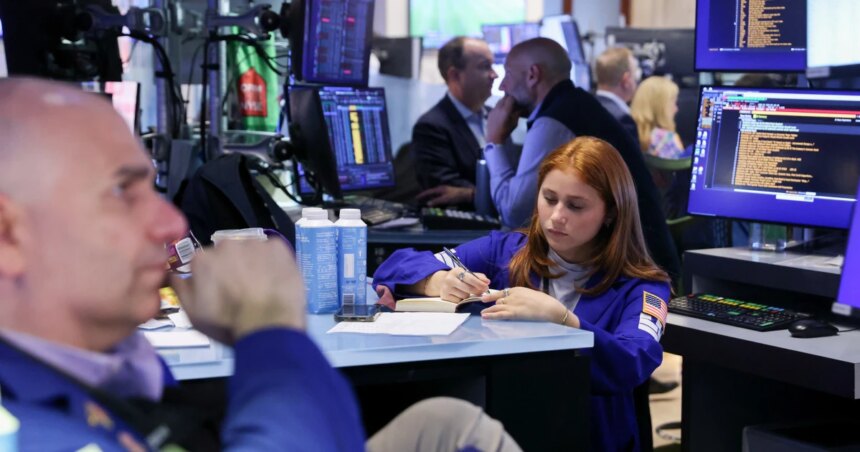
Markets across the globe experienced a significant downturn on Tuesday, driven by growing concerns over the high valuations of major technology stocks, particularly in the artificial intelligence (AI) and semiconductor sectors. This wave of selling was led by Elon Musk’s SpaceX, which has been struggling since its ambitious stock market debut just days prior.
Investors are increasingly anxious about the implications of rising inflation, which has been exacerbated by the ongoing conflict in Iran and disruptions in the Strait of Hormuz. These geopolitical tensions are raising fears of potentially higher interest rates, which could in turn increase borrowing costs for companies heavily investing in AI infrastructure.
The Nasdaq 100 futures plummeted by 2.8%, indicating a potential loss of over $1 trillion in market capitalization should the decline persist through the trading day. Other indices were not spared from the losses either; S&P 500 futures fell 1.6% and Dow futures dropped nearly 300 points. Even smaller companies, tracked by the Russell 2000 index, saw declines of 1.4%.
Pre-market trading revealed a stark decline in shares of major tech firms. Investors saw Intel, Marvell, Western Digital, and AMD slump by more than 5%, while Broadcom, Nvidia, Tesla, and Alphabet each fell over 3%. In the bond market, there were mixed signals, with short-term U.S. Treasury yields inching upwards while longer-dated yields, such as the 10-year, dipped slightly.
SpaceX’s stock, which was already on a downward trajectory, saw another dip of approximately 4% in pre-market trading, bringing its value down to around $147. This is notably lower than the $150 opening price from its recent IPO but still above its offering price of $135. The stock has lost over $900 billion in market value since reaching a peak of $225 per share just a week ago. On Monday, SpaceX shares suffered a staggering decline of nearly 17%, wiping out $400 billion in value—the second-largest one-day loss for any stock on record, as reported by Bloomberg.
The sell-off intensified following the announcement of SpaceX’s inaugural bond offering, which aims to raise approximately $20 billion to support its ambitions in AI. This announcement came shortly after the company successfully raised $85 billion through its IPO.
Meanwhile, all seven of the tech giants collectively referred to as the “magnificent seven”—including Alphabet, Amazon, Apple, Meta Platforms, Microsoft, Nvidia, and Tesla—were experiencing declines in pre-market trading, with Nvidia and Tesla projected to be hit the hardest.
Alphabet faced its worst single-day drop in a year on Monday due to high-profile departures from its AI team, which contributed to a continued downward trend on Tuesday, leading to an additional dip of 2.3%. This negative sentiment was echoed globally, affecting the South Korean market where the Kospi index fell sharply by 10%. This decline was largely driven by significant losses in major firms like Samsung and SK Hynix, which dropped over 12%.
In Europe, the sell-off was mirrored as the Stoxx 600 index declined by approximately 1%, with Germany’s DAX index falling 1.3%. Semiconductor manufacturer Infineon was highlighted as one of the largest decliners, experiencing a drop of more than 5%.
JPMorgan traders noted that the current market movements could reflect “anxiety” ahead of the upcoming earnings report from memory chip manufacturer Micron, which is expected on Wednesday afternoon. Dan Ives, head of tech research at Wedbush Securities, echoed this sentiment, stating that there is notable nervousness surrounding the crucial memory chip sector, particularly as Micron’s shares dipped by 9% in early trading.
Despite the turmoil, Micron’s shares have surged over 300% since the start of the year, while Samsung and SK Hynix have seen respective increases of 160% and over 800% in the past year. Ives remarked that the market will likely continue to encounter “gut check moments” amid the swiftly evolving landscape of tech investments, particularly as the AI revolution develops.
Adding to the mix, oil prices slipped slightly as traders processed the latest developments regarding the ongoing discussions aimed at resolving the conflict between the U.S. and Iran. While there have been some signs of traffic resuming through the Strait of Hormuz following a tentative truce—such as the passage of 15 tankers on Monday—concerns remain about the speed of recovery in oil supply. Analysts from Société Générale indicated that while immediate supply worries have eased, logistical challenges may delay the return to normalcy in the vital Strait of Hormuz.