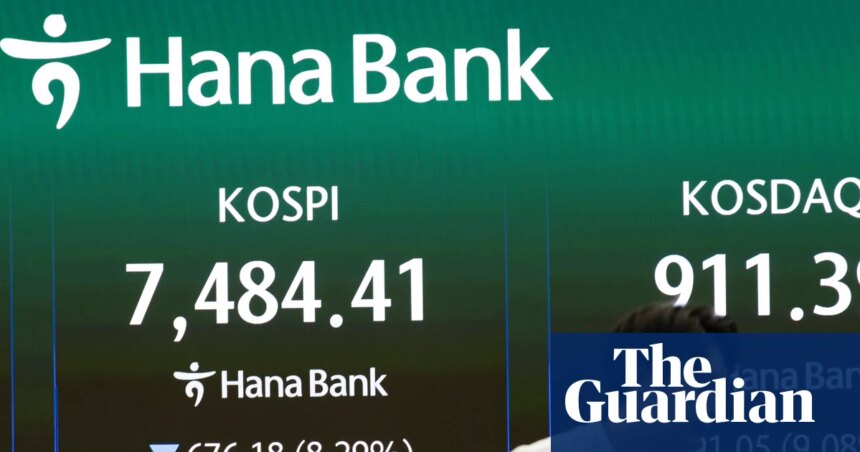
Global stock markets experienced a significant decline as concerns about the future of technology stocks intensified. This downturn was coupled with a noticeable rise in oil prices, attributed to renewed conflicts in the Middle East, particularly the escalation between Iran and Israel.
On Monday, stock markets across Asia and Europe reported losses, following a drastic sell-off in U.S. tech stocks late last week. Investors are increasingly worried about how major companies, especially those involved in the burgeoning artificial intelligence sector, will manage their hefty spending plans amidst a changing financial landscape. Brent crude oil prices surged nearly 5%, reaching $97.60 a barrel after an Israeli strike on Beirut prompted retaliatory fire from Iran.
In Asia, where economies heavily rely on oil imports, markets faced severe drops. South Korea’s Kospi index plummeted nearly 9% at one point, leading to a temporary suspension of trading. Major semiconductor firms, notably Samsung Electronics and SK Hynix, saw their shares decline by 9% and 6% respectively, contributing to the index’s sharp plunge. Japan’s Nikkei 225 index fell by 3%, while Hong Kong’s Hang Seng experienced a 1.5% decrease.
In London, the FTSE 100 opened down by 0.4%, with companies like Rolls-Royce and International Airlines Group suffering notable losses. Conversely, shares of oil companies such as BP and Shell rose, reflecting the changing dynamics in energy markets. Furthermore, stock exchanges in Germany, France, and Spain followed suit, with broader European markets indicating similar trends. Predictions for a downturn in U.S. markets later in the day added to the bleak overall outlook.
European companies central to the AI boom also faced acute declines at the start of trading. Shares in chip manufacturers like BE Semiconductor Industries and ASML fell by 4.5% and 3.2% respectively. Other notable drops included nearly 6% for German tech firm Aixtron and a 5% decrease for Finland’s telecommunications company Nokia. The previous steep sell-off in tech stocks marked a challenging backdrop, with the tech-heavy Nasdaq index losing almost 5% recently, while the S&P 500 index also saw a 2% decline, ending a consecutive nine-week winning streak.
Investor sentiment has shifted as concerns about the valuation of AI stocks mount, especially in light of rising inflation and anticipated interest rate hikes. Susannah Streeter, chief investment strategist at Wealth Club, noted that markets are now factoring in a higher probability of interest rate increases from the Federal Reserve this year. She highlighted that while technology giants are seeking fresh funding to finance ambitious capital expenditures, the fear of potentially obsolete investments looms large.
Charu Chanana, chief investment strategist at Saxo, observed that the market is becoming increasingly selective regarding AI investments. He suggested that investors are placing a greater emphasis on clear earnings delivery, monetization, capital expenditure discipline, and funding returns—a shift reflecting a potential recalibration rather than a fundamental change in the AI narrative.
The rise in Brent crude prices came after a notable dip to $93 a barrel last week, coinciding with direct strikes between Iran and Israel, marking a significant escalation since the ceasefire in April. Heightened tensions in this region have fostered anxieties regarding the continued operation of the strait of Hormuz, a critical shipping route that facilitates a fifth of the world’s oil and gas supply.
In a separate development, Donald Trump expressed mixed feelings regarding the Israeli strikes, indicating that they were not coordinated with the U.S. and voicing discontent over the situation, underscoring the complexities of international relations as tensions escalate in the region.