Global stock markets experienced significant turmoil on Tuesday, with steep declines primarily driven by a sell-off in technology companies. Previously, firms specializing in artificial intelligence and chip manufacturing had propelled markets to record highs, thereby exerting a disproportionate influence on major market indexes. However, a downturn that began in the United States the day before rippled across the globe, impacting Asian markets particularly hard.
In premarket trading on Tuesday, major U.S. tech companies, including Alphabet and Amazon, continued their decline, adding to the losses sustained on Monday. Meanwhile, SpaceX, the rocket and AI venture led by Elon Musk, saw its stock tumble more than 20 percent over the past three trading sessions following an initial surge after its debut. While still above the initial public offering price, the continued slide has raised investor concerns.
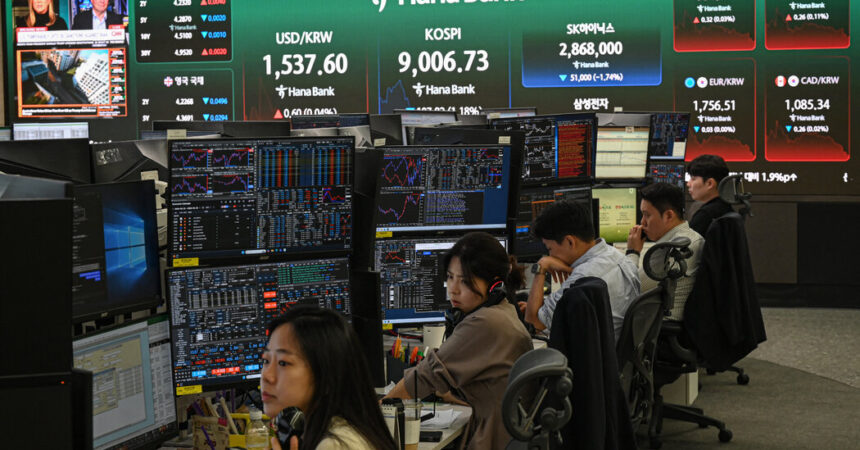
The most pronounced drop occurred in South Korea, which had been the world’s top-performing stock market since the beginning of 2025. The country’s benchmark Kospi index plummeted by 10 percent, prompting a 20-minute trading halt enforced by the exchange. The dramatic rise of South Korea’s market over the past year was largely due to the impressive performance of its two largest memory chip manufacturers, Samsung Electronics and SK Hynix. These companies produce semiconductors critical for AI technology, and as their stock prices surged, retail investors flocked to the market. On Tuesday, however, shares of both companies fell more than 12 percent.
Alexander Redman, chief equity strategist at brokerage CLSA, commented on the current market conditions at an investor conference in Seoul. He noted that while large drops such as this would typically incite panic, they have recently become somewhat expected. “It’s unnerving that you’re seeing this kind of volatility,” he remarked, adding that the market felt “very, very frothy.” Redman expressed uncertainty about whether South Korean shares would rebound quickly or if the recent decline signaled a more long-term downturn.
In Japan, the Nikkei index saw a decline of 3.6 percent, while markets in Taiwan and Hong Kong also recorded losses of over 1 percent. As the global correction intensified, futures for the S&P 500 indicated a 1.5 percent drop, suggesting that U.S. stocks were likely to continue this downward trend when trading commenced in New York. Futures for the Nasdaq, known for its concentration of tech stocks, were down by 2.5 percent.
In Europe, the Stoxx 600 index, which tracks the continent’s largest companies, fell by 1 percent as well. Semiconductor firms, including STMicroelectronics of Switzerland, Infineon of Germany, and ASML of the Netherlands, faced notable declines, contributing to the overall bearish sentiment in markets around the world.