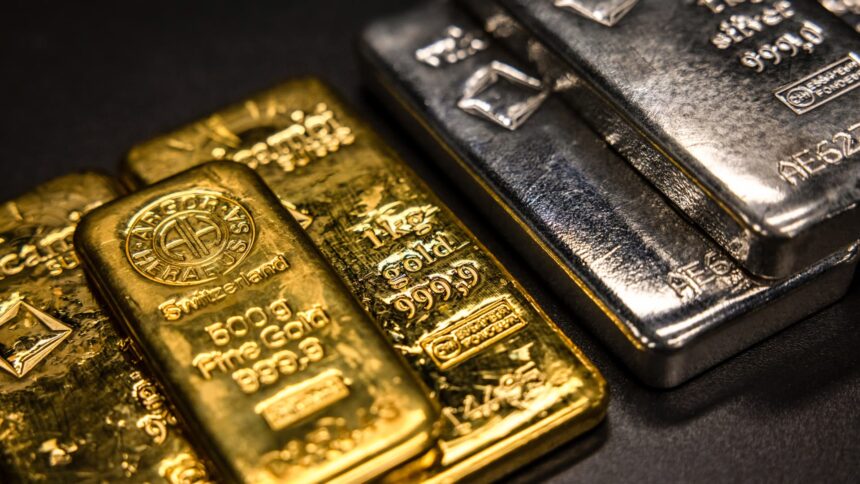
Gold continued its impressive upward trajectory on Thursday, surpassing the $5,500 per ounce mark and reaching an all-time high. Spot gold prices climbed by more than 3%, settling at $5,501.18 an ounce, according to LSEG data. Gold futures for February also spiked over 3%, achieving $5,568.66 per ounce during trading. Similarly, silver prices experienced a notable surge, with spot silver advancing over 2% to $119.3 per ounce, while U.S. silver futures for March rose nearly 5% to $118.73 per ounce. This marks a significant milestone as silver exceeded $117 an ounce for the first time, following a staggering increase of over 145% in 2025, according to the same data. The white metal has appreciated nearly 65% so far this year.
The recent price increases have positively impacted a spectrum of metals, encapsulating everything from platinum to palladium and even base metals. Analysts have observed a growing demand, primarily fueled by investors seeking refuge from a combination of geopolitical uncertainties, escalating government debt, and concerns regarding the trajectory of interest rates and currencies. Ongoing purchasing by central banks has bolstered gold’s standing, with some experts suggesting that expectations of future monetary easing have enhanced the appeal of non-yielding assets compared to traditional safe havens like Treasurys.
The momentum in the silver market has been particularly pronounced, with its industrial applications—such as in solar power, electronics, and electrification—contributing to its rising prices amid supply constraints. Nicky Shiels from MKS PAMP highlighted the unprecedented volatility in precious metals markets, remarking that “I would label the precious markets as broken.” Analysts have noted that current prices are influenced less by physical supply and demand and more by erratic liquidity flows, resulting in significant price swings detached from underlying fundamentals.
Maximilian Tomei, CEO and co-portfolio manager at Galena Asset Management, also underscored that the recent price fluctuations stem less from genuine demand. He pointed out that gold functions similarly to a currency, and as the “denominator” (i.e., the dollar) weakens, gold’s price rises correspondingly. Over the last year, the dollar index has declined approximately 11%. However, Tomei cautioned that while there is some fundamental demand for precious metals, it alone does not justify the magnitude of the price increases observed. He emphasized that factors like excess liquidity in global markets play a crucial role in driving prices up, as investors seek alternative avenues for their capital amidst inflated asset prices.
Furthermore, the decline in government bonds’ traditional status as a safe haven has been marked by a global sell-off, contributing to the overall trend. This shift has resulted in exaggerated price movements, particularly in smaller precious metal markets where even modest inflows can significantly impact prices. Guy Wolf, global head of market analytics at Marex, pointed out that the recent surge in speculative capital is distorting price actions in the market. He stressed that production constraints prevent the physical supply from rapidly increasing to accommodate soaring demand, leading to a scenario where prices appear disconnected from actual supply and demand dynamics.
Despite these concerns, not all market observers agree that price discovery mechanisms have completely faltered. Gautam Varma, managing director of strategic advisory V2 Ventures, cautioned against declaring the precious metals market as “broken.” He acknowledged the influence of speculative capital while suggesting that its presence may not solely stem from fundamental supply and demand forces.
As the precious metals market continues to exhibit remarkable volatility and record price levels, analysts remain divided on the underlying drivers and the sustainability of these trends, indicating a complex and evolving landscape for investors and stakeholders.