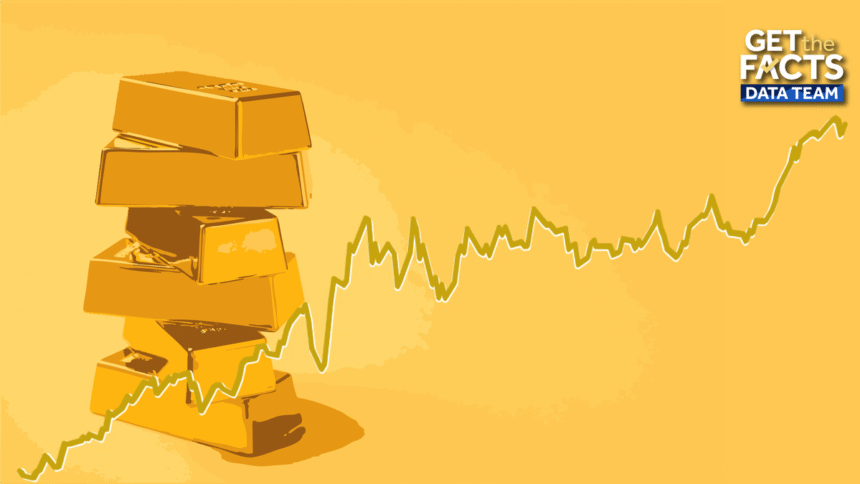
Gold prices are experiencing a remarkable surge, edging closer to the historic $4,000 mark. This precious metal, regarded for its long-term store of value, has witnessed a staggering increase of 45% year-to-date, climbing from $2,669 at the beginning of January. Its recent ascent can be attributed to growing investor interest, particularly in light of anticipated economic uncertainties such as the potential U.S. government shutdown, which has historically correlated with rises in gold prices.
Gold has been esteemed throughout history as the “currency of kings,” valued not only for its beauty but also for its unique chemical properties—durability, malleability, and resistance to tarnish. In contemporary markets, gold has transitioned from a primary trade item to a sought-after safe-haven asset, allowing it to be physically stored and exchanged even in uncertain times.
Professor Andrea Bubula, an economic analyst at Columbia University, explains that the global financial crisis prompted central banks to diversify their reserves beyond U.S. dollars, recognizing the risks of asset confiscation, as seen during the Venezuelan banking crisis in 2009. “Gold is good because it is typically negatively correlated with markets, so when markets do badly, gold does well,” he noted.
The World Gold Council’s recent report indicates a significant shift in central banks’ purchasing behavior, revealing that their collective gold reserves have doubled in the past three years to about 1,000 tons, compared to a stable 400 to 500 tons over the previous decade. Taylor Burnette, the Council’s research lead for the Americas, highlights three main categories driving gold demand: jewelry and technology, investors, and central banks, with the latter being the most pronounced source of current interest.
He notes that individual investors, from family offices to high-net-worth individuals, are increasingly diversifying their portfolios to include gold, typically allocating around 5% of their investments. Burnette emphasizes gold’s high liquidity, attributing this to its standardized weight and purity, making it easy to trade without credit risk.
Additional factors fueling gold’s price surge include a weakening U.S. dollar and declining interest rates, both of which enhance the opportunity cost of holding gold. The U.S. dollar index, which opened at 109.23 on January 2, has decreased over 10% in recent months. This relationship highlights that as the dollar weakens, gold prices generally rise. Bubula points out that this inverse correlation is not limited to the dollar; gold is similarly more expensive in other currencies, such as euros and yen.
The World Gold Council’s second-quarter report reveals that total gold demand rose to 1,249 metric tons, or over 40 million troy ounces, marking a 3% year-on-year increase. Significant contributors to this demand included gold ETF investments and Asian-listed funds, which added 170 metric tons and 70 metric tons, respectively. The report attributed this surge to strong investment flows, spurred by geopolitical uncertainties and sustained price momentum.
Bubula underscores that investors buy gold partly to hedge against potential losses compared to investments in stocks or bonds, especially during periods of market volatility. However, it’s noteworthy that investor sentiment has leaned bearish in recent months, according to the AAII Sentiment Survey, revealing a cautious outlook among stock market investors.
Despite its advantages, gold investment is not without challenges. Costs related to storage and insurance can burden investors, and the risk of theft poses additional concerns for physical gold holders. Unlike stocks and bonds, gold does not yield interest payments, which can make it less attractive from a yield perspective.
Experts continue to debate gold’s place in investment portfolios, as its unique attributes and historical significance keep it at the forefront of financial discussions amidst a tumultuous economic landscape.