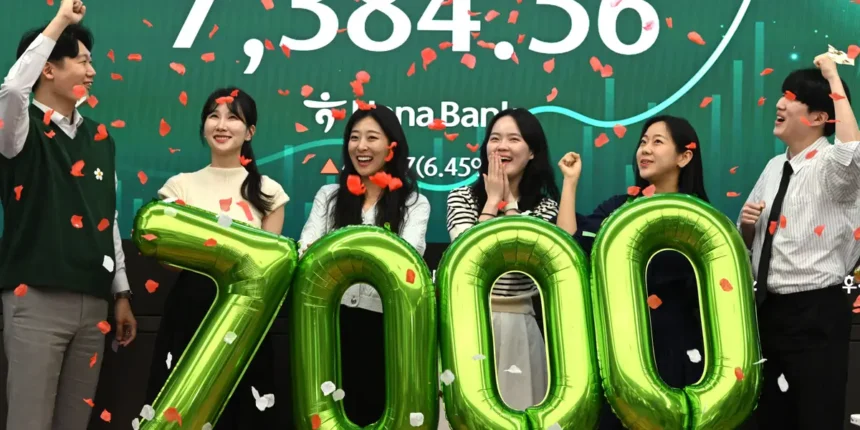
South Korea’s stock market has captured global attention with one of the most remarkable rallies this year, and experts at Goldman Sachs believe it still has room for growth. In a recent note, the investment bank expressed strong conviction in South Korean equities, giving the country an “overweight” rating and significantly raising its 12-month target for the Kospi index from 8,000 to 9,000. The Kospi, which recently surpassed the pivotal 7,000 mark, is currently trading at approximately 7,400, reflecting an impressive 77% increase since the beginning of the year.
This bullish performance is primarily attributed to the escalating demand for memory semiconductors, a field largely dominated by industry giants Samsung Electronics and SK Hynix. Goldman Sachs highlighted that Samsung has recently achieved a valuation of over a trillion dollars, further underscoring the market’s newfound optimism. The firm noted, “The prospect of sustained high profits for the semiconductor memory sector suggests the market is mispricing the durability of earnings,” indicating a potential underestimation of the sector’s long-term profitability.
Despite the substantial gains, South Korean stocks continue to trade at relatively modest valuations. Goldman predicts a startling 300% growth in corporate earnings from hardware and semiconductor stocks by 2026, driven by a predicted record supply shortfall in DRAM and NAND chips. These types of memory chips are critical for AI servers and data centers, and the firm pointed out that strong demand, particularly from hyperscale investments, is leading to increasing memory prices.
This optimistic outlook arrives as discussions grow around whether the AI investment trend is becoming oversaturated, especially following significant gains in U.S. tech stocks. Since the start of 2025, the Kospi has more than tripled, marking a stark turnaround for a market that had previously suffered from the so-called “Korea discount.” This phenomenon has plagued South Korean equities for years but has been addressed through corporate governance reforms and initiatives promoting shareholder value.
The surge in South Korean stocks has been buoyed not only by local retail investors but also by foreign investment, attracted by the global frenzy surrounding AI technology spending. As the dynamics of the South Korean market continue to evolve, analysts are watching closely to see how these trends will develop in the months ahead.