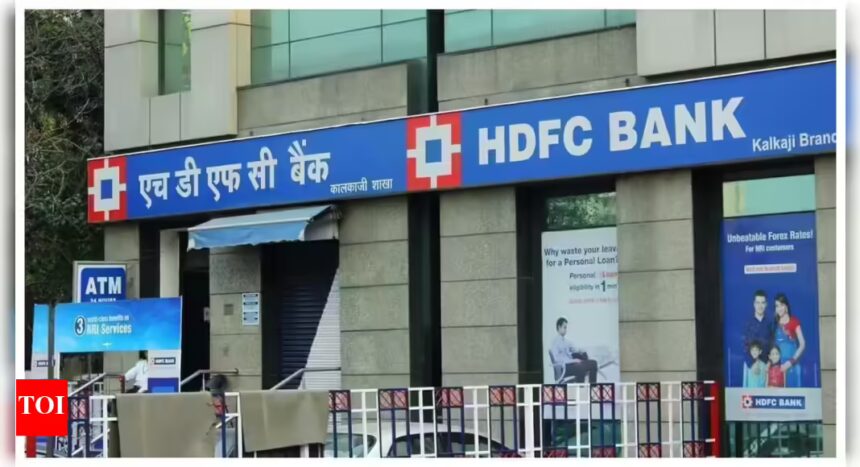
HDFC Bank has announced a robust 10.8% increase in standalone net profit, reaching ₹18,640 crore for the quarter ending September 2025. This growth is attributed to a significant rise in non-interest income and continued advancements in asset quality. The bank reported net interest income climbing by 4.8% year-on-year to ₹31,550 crore, while non-interest income surged by an impressive 25% to ₹14,350 crore. Consequently, total income for the quarter escalated by 10.4% to ₹45,900 crore.
Operating expenses rose by 6.4% to ₹17,980 crore, and provisions saw a notable increase of 29.6% to ₹3,500 crore. Profit before tax experienced a commendable increase of 11%, amounting to ₹24,420 crore. The net interest margin on total assets was pegged at 3.27%, with a core margin of 3.4% on interest-earning assets.
Sashidhar Jagdishan, the bank’s managing director and CEO, highlighted the visible improvement in economic activity across various customer segments and product offerings. He credited this favorable environment to a combination of tax benefits, GST adjustments, and interest rate reductions, suggesting that these factors create an opportunity for accelerated loan growth. Jagdishan noted that the bank’s growth rate had been deliberately moderated during FY25 in order to lower the credit–deposit ratio from 110% at the time of the merger to 96.5%. He expressed optimism that HDFC Bank is on track to exceed market growth in FY27.
Addressing the bank’s operational stability, Jagdishan reaffirmed that HDFC Bank is well-positioned in terms of capital and distribution, maintaining crucial metrics such as net interest margin, cost-to-income ratio, and return on assets. While some margin volatility is anticipated—due to time taken by deposits to reprice relative to loans—he remains confident in the bank’s overall asset quality, which has been stable over the long term.
Investment in technology is a key focus for HDFC Bank as part of its long-term strategy. Jagdishan mentioned that significant resources have been allocated towards core platforms, middleware, and emerging technologies such as GenAI. Additionally, an innovation unit has been established, concentrating on “lighthouse experiments” that aim to enhance processes, reduce turnaround times, improve customer experience, and deliver measurable benefits within the next 18 to 24 months.
Regarding deposits, HDFC Bank reported a year-on-year increase of 12.1%, totaling ₹28 lakh crore by the end of September 2025. Advances grew by 9.9% to ₹27.7 lakh crore, with a steady retail-to-wholesale loan mix of 56:44. The CASA (current account savings account) ratio stood at 34%, dipping from 35% a year earlier.
Asset quality indicators also demonstrated improvement, with gross non-performing assets (NPAs) decreasing to 1.24% from 1.4%, and net NPAs falling to 0.4% compared to 0.5% the previous year. Excluding agriculture loans, the gross NPA ratio was recorded at 0.99%. The rise in credit costs, net of recoveries, was modest, increasing to 37 basis points from 29 basis points.
Moreover, the total capital adequacy ratio for HDFC Bank has increased to 20%, and the Common Equity Tier 1 (CET1) ratio rose to 17.5%. The bank expanded its physical presence by opening 453 new branches over the year, growing its total to 9,545 branches, and increased its customer base from 96 million to 99 million.
In light of forthcoming draft guidelines on acquisition financing, Jagdishan remarked that, despite it being early for a comprehensive analysis, the proposals appear beneficial for Indian banks and corporate customers alike. He characterized the potential regulatory changes as a win-win scenario, poised to introduce new product offerings for banks and lower costs for customers engaged in transactions.