Shares of Hewlett Packard Enterprise (HPE) surged by an impressive 30% on Monday following the release of second-quarter results that significantly outperformed market expectations. The company’s earnings per share (EPS) of 79 cents was notably higher than the anticipated 53 cents, marking the largest EPS beat the company has seen since February 2018. Revenue for the quarter reached $10.68 billion, exceeding the forecast of $9.79 billion and reflecting a remarkable 40% increase compared to the same period last year.
A major contributor to this success was the company’s performance in the Cloud and AI sectors, which generated $7.71 billion in revenue, surpassing the StreetAccount estimate of $6.87 billion. The standout performer, however, was the server unit, which reported revenue of $5.45 billion—well above the $4.66 billion projected by analysts. This unexpected growth prompted HPE to revise its full-year EPS guidance upward by a full dollar, now expecting fiscal year 2026 EPS to range from $3.35 to $3.45, a significant increase from the previous estimate of $2.30 to $2.50. The company noted that it is currently tracking two years ahead of its long-term financial plan.
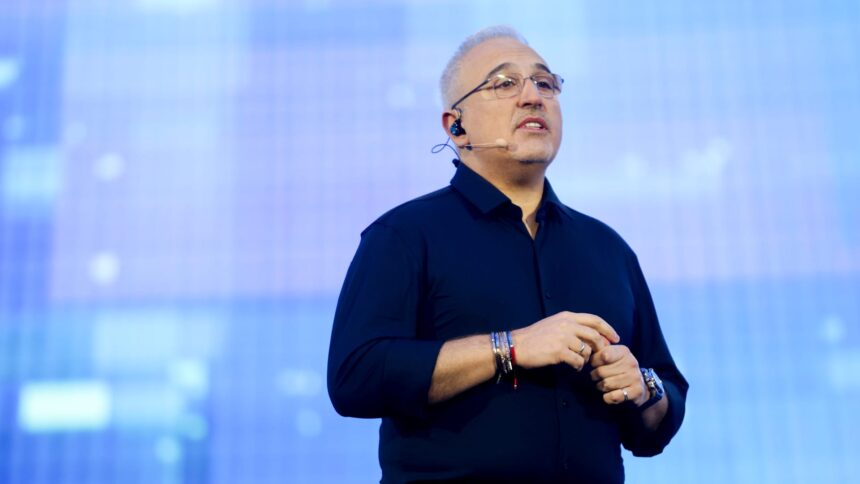
CEO Antonio Neri shared insights during an interview with CNBC, explaining that traditional server bookings have experienced triple-digit growth and that the company is facing its largest backlog ever. He emphasized that organizations are increasingly investing in modernizing their infrastructures and scaling AI capabilities: “Customers continue to invest in modernizing their infrastructure and scaling AI, and our performance shows the strength of our combined networking portfolio,” Neri stated.
Amid these developments, Neri highlighted a trend where industries focused on security are rapidly accelerating their AI initiatives on-premises rather than in the cloud—areas where HPE aims to provide targeted solutions, particularly for national laboratories and enterprises. Analyst Patrick Moorhead explained that HPE’s recent success is closely tied to increased AI profitability and achieving operational targets ahead of schedule. However, he cautioned that the ongoing global memory shortage poses a potential risk, with costs expected to remain high until at least 2027.
In a striking turnaround, HPE reported a net income of $624 million, translating to 44 cents per share, compared to a net loss of $1.05 billion, or 82 cents per share, incurred the previous year. This financial turnaround coincided with the announcement of a new server rack at the Computex conference in Taiwan, which will feature Nvidia’s new Vera central processing units (CPUs), now in full production.
Nvidia CEO Jensen Huang emphasized the significance of these new CPUs, stating that millions are set to be produced and will be available in the coming fall. The New York Stock Exchange is among the first customers planning to utilize these new chips on HPE servers to manage over a trillion messages daily. Neri further explained that the new ProLiant server is optimized for high-performance AI workloads—requirements essential for real-time reasoning in critical applications.
The 12th generation ProLiant server, optimized for these demanding tasks, will be accessible in the fall, symbolizing HPE’s commitment to providing cutting-edge infrastructure for enterprise-level AI applications.