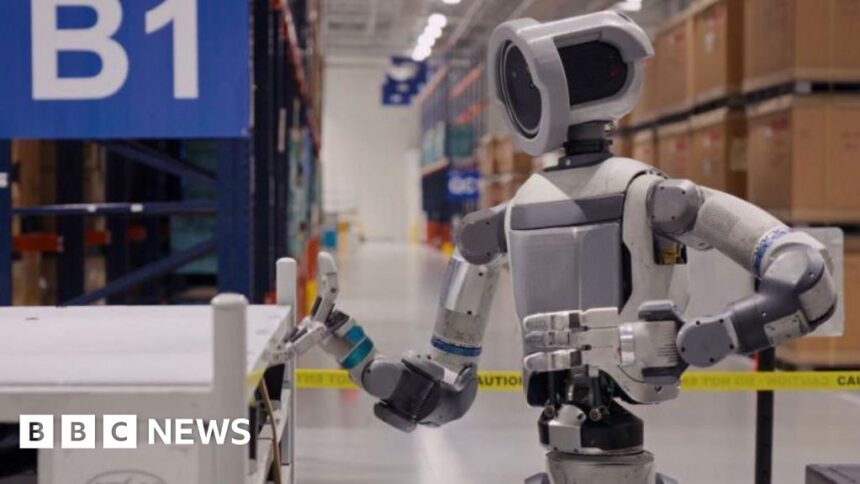
Hyundai Motor Group has announced plans to roll out human-like robots, known as Atlas, in its factories starting in 2028, as companies across various industries increasingly embrace advanced robotics technology. The South Korean automotive giant showcased the Atlas robot, developed by Boston Dynamics, during the Consumer Electronics Show (CES) in Las Vegas, capturing attention with its sophisticated capabilities.
Hyundai intends to integrate these humanoid robots into its global manufacturing network, which includes a significant facility in Georgia, notable for its involvement in a major immigration raid in 2025. This move aligns Hyundai with other leading firms, such as Amazon, Tesla, and China’s BYD, all of whom are exploring the use of humanoid robots to enhance operational efficiency.
The Atlas robots are designed for general industrial applications, with the ability to work alongside human operators and autonomously manage machinery. The company expects that the introduction of these robots will alleviate physical strain on human workers, perform hazardous tasks, and facilitate broader adoption of robotic technology in manufacturing settings.
While the specific number of robots to be deployed and the total investment for the project remain undisclosed, Hyundai’s vice chair, Jaehoon Chang, commented on the potential job displacement that could arise from automation. He emphasized, however, that the need for human workers to train and oversee the robots will remain essential.
This announcement follows Hyundai’s commitment made back in 2025 to invest over $20 billion in the U.S., a plan that supports initiatives aimed at boosting domestic manufacturing, including the development of autonomous driving technologies and artificial intelligence. The company’s Georgia battery plant, operated in collaboration with LG Electronics, has emerged as a cornerstone of its U.S. operations.
The facility gained notoriety in September 2025 when U.S. immigration officials conducted a large-scale raid, detaining hundreds of employees, including around 300 South Korean nationals. The incident triggered a wave of criticism and diplomatic discussions between the U.S. and South Korea, highlighting concerns about the future of foreign investment in the United States. The aftermath involved a commitment from Washington and Seoul to address the issues raised by the raid, including a personal apology from the White House to Hyundai’s executive team.