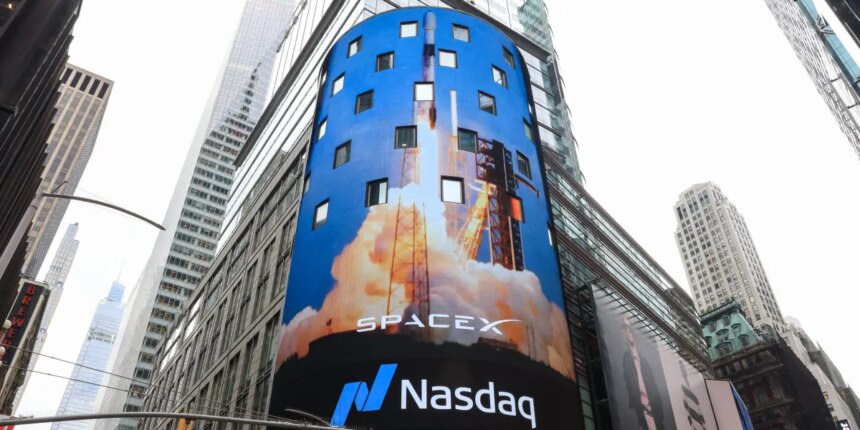
Investors are buzzing about SpaceX’s monumental initial public offering (IPO) and are eager for the upcoming public listings of OpenAI and Anthropic later this year. However, there are growing concerns about the sustainability of this upward trend in the market.
Despite significant shocks to the stock market, such as the trade tensions during former President Donald Trump’s administration and ongoing geopolitical tensions in the Middle East, the market has shown remarkable resilience. Yet, a rising tide of new stock issuances has prompted Wall Street to consider whether a market correction may be on the horizon.
In total, SpaceX managed to raise a staggering $75 billion, while its artificial intelligence competitors are projected to attract tens of billions more from investors. This surge in activity comes in the wake of Alphabet, the parent company of Google, successfully netting $85 billion through a separate stock offering earlier in the month.
Jonas Goltermann, chief markets economist at Capital Economics, highlighted the need for cautious optimism. He noted that major IPOs often signal a peak in market conditions, referring to the equity issuance spikes seen in 1999, 2007, and 2021—years that preceded notable downturns. Goltermann underscored that these periods of high equity issuance typically coincide with economic recessions that followed the tech and housing bubbles.
Even before the notable IPOs from SpaceX and Alphabet, there was an uptick in net equity issuance from U.S. non-financial companies early this year. Goltermann suggests that the forthcoming IPOs from OpenAI and Anthropic could mirror the issuance patterns seen in previous market cycles.
Conversely, analysts at Deutsche Bank provided a more optimistic perspective. They analyzed historical data on new share supply and found that equity issuance generally aligns with strong performance in the stock market, rather than signaling impending stress. According to analyst Jim Reid, companies are inclined to issue new shares when market demand is robust, earnings are strong, and investor sentiment is high.
Reid pointed out that past issuance waves have yielded median equity returns of around 8% over three months and over 20% within a year, with the notable exception of the Great Financial Crisis, when companies rushed to raise capital. The recent uptick in U.S. stock issuance has escalated dramatically, from an early 2023 quarterly run rate of $30 billion to around $120 billion now.
Reid emphasized that the current market environment is marked by strong equity demand, fueled by healthy earnings growth and significant buyback activity. He concluded that household balance sheets are well-positioned to absorb new stock offerings, suggesting that strong demand—not supply—will likely dictate the market’s trajectory moving forward.
As the market watches closely, both caution and optimism are informing investor sentiment as the landscape evolves leading into the anticipated IPOs of tech giants.