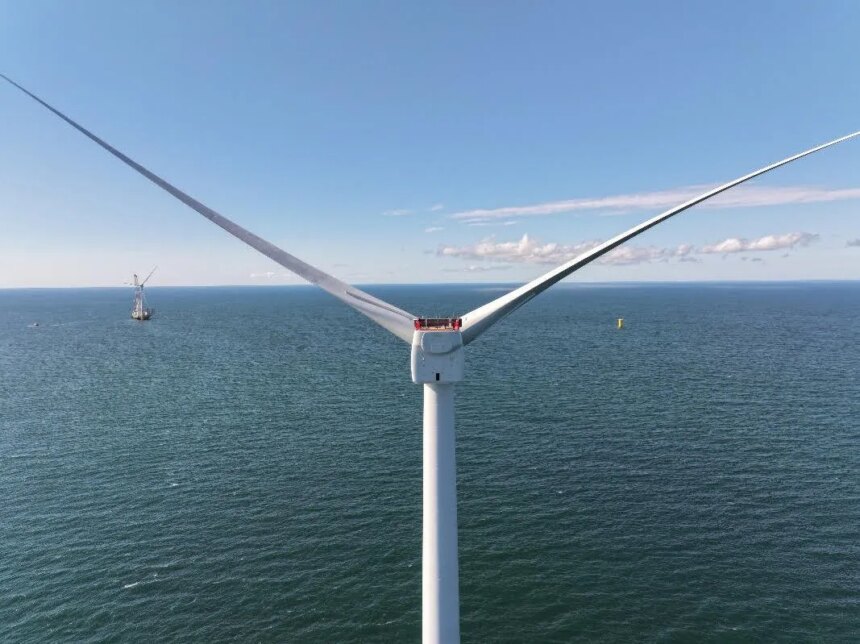
The Trump administration faced significant legal challenges this week as federal judges allowed the resumption of construction on multiple offshore wind farms along the East Coast. The Department of the Interior had previously issued a stop work order on five projects, which together are expected to contribute 6 gigawatts of generating capacity, citing national security concerns as the rationale.
The halted projects include Revolution Wind off Rhode Island, Empire Wind off New York, and Coastal Virginia Offshore Wind. Shortly after the December cease-and-desist order was announced—a move that came just before Christmas and was set to last for 90 days—developers filed lawsuits against the administration, seeking to lift the restrictions.
The government had argued that the wind farms could disrupt radar operations, an issue that has been discussed in detail throughout the siting and permitting process. Despite these concerns, courts seemed skeptical of the government’s justification during initial hearings. U.S. District Judge Carl Nichols, a Trump appointee, noted that the administration’s legal brief failed to adequately address the arguments put forth by Equinor, the company behind Empire Wind. He highlighted that the brief did not even use the term “arbitrary,” which was a key point of Equinor’s contention.
Similarly, U.S. District Judge Jamar Walker questioned why the government had requested a halt to construction when its primary focus appeared to be the operational phase of the wind farms. Walker described the Interior Department’s order as overly broad, particularly concerning the Virginia project.
While three projects are set to resume construction, two others remain in a state of uncertainty as they await judicial review. Ørsted, developer of Sunrise Wind, has a hearing scheduled for early February, and Vineyard Wind 1 filed its lawsuit recently.
Looking ahead, the Department of Energy anticipates that the East Coast alone could harness up to 110 gigawatts of offshore wind capacity by 2050, which would significantly aid some of the country’s most densely populated areas. The Northeast currently faces high electricity costs, exacerbated by scrutiny directed at the Mid-Atlantic’s grid operator amid rising prices. Offshore wind is recognized as one of the most cost-effective forms of generating capacity, offering a viable solution for alleviating electricity costs in these regions.
On a broader scale, the potential for offshore wind is remarkable. Nationally, it could generate approximately 13,500 terawatt-hours of electricity annually, which amounts to three times the current consumption levels in the United States.