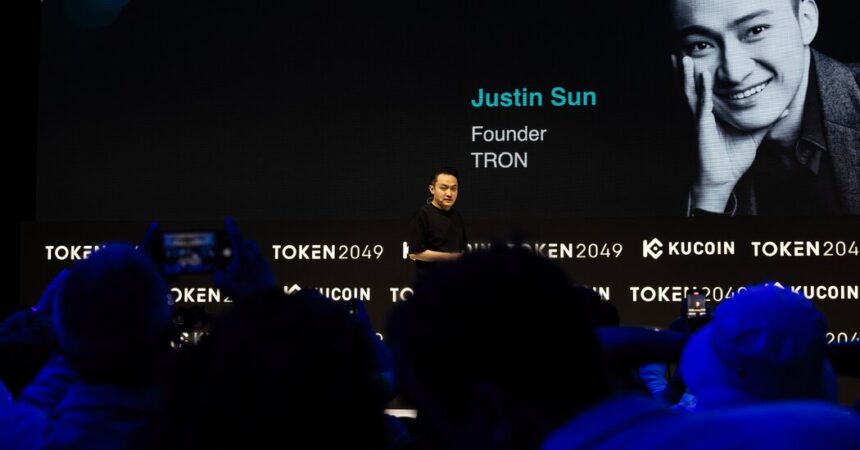
In a dramatic turn of events, cryptocurrency entrepreneur Justin Sun has filed a lawsuit against World Liberty Financial, the Trump family’s cryptocurrency venture, following a significant financial investment. The lawsuit, initiated in the U.S. District Court in Northern California, contends that World Liberty attempted to coerce him into purchasing an additional digital currency while threatening him with law enforcement if he did not comply.
Sun’s troubles with World Liberty begin after he bought $75 million worth of its digital coins to support the company’s mission. Initially, the partnership appeared fruitful; Sun’s involvement came during a challenging period for World Liberty when they were working to establish their cryptocurrency, $WLFI. The collaboration was perceived by many as a strategic alliance between Sun and the Trump family, drawing scrutiny given Sun’s ongoing battle with the Securities and Exchange Commission (SEC) over fraud allegations, for which he eventually settled a $10 million claim.
The lawsuit accuses World Liberty of “egregious misconduct,” claiming that company executives tried to pressure Sun into investing $200 million in a new stablecoin, named USD1, and sought equity investments. According to the complaint, when Sun resisted these overtures, World Liberty “became hostile,” subsequently restricting his access to his initial investments.
World Liberty began its operations in September 2024, teaming up with various partners, including President Trump’s associate Steve Witkoff and his sons Zach and Alex, who helped launch the $WLFI cryptocurrency. Unique for its design as a governance token, $WLFI provided holders with a degree of say in the company’s trajectory. However, the coins were initially ‘locked,’ prohibiting buyers from reselling them immediately, which led to slower-than-expected early sales. Nevertheless, following Sun’s investment, World Liberty enjoyed a surge in sales, generating over $500 million, a substantial financial win for the Trump family.
The situation escalated when, according to the lawsuit, World Liberty allegedly prevented Sun from liquidating his holdings once it became profitable to do so. After a period of conflict, the company finally started permitting sales of $WLFI for other investors, but Sun remained unable to access his funds.
As the dispute intensified, members of the World Liberty team claimed that Sun’s documentation related to compliance—known in financial circles as “know your customer” or KYC—was inadequate. Sun’s complaint suggests that this assertion was merely a pretext to manipulate him further, indicating a breakdown in what was initially a promising business relationship.
While a representative for Sun has not publicly commented on the situation, World Liberty’s chief executive, Zach Witkoff, has dismissed Sun’s allegations as “entirely meritless,” asserting that the company acted in self-defense to protect itself and its users.
This ongoing legal confrontation has raised eyebrows in both the cryptocurrency community and beyond, highlighting tensions between emerging digital currencies and traditional financial oversight mechanisms, and throwing into question the partnerships formed in the high-stakes world of crypto.