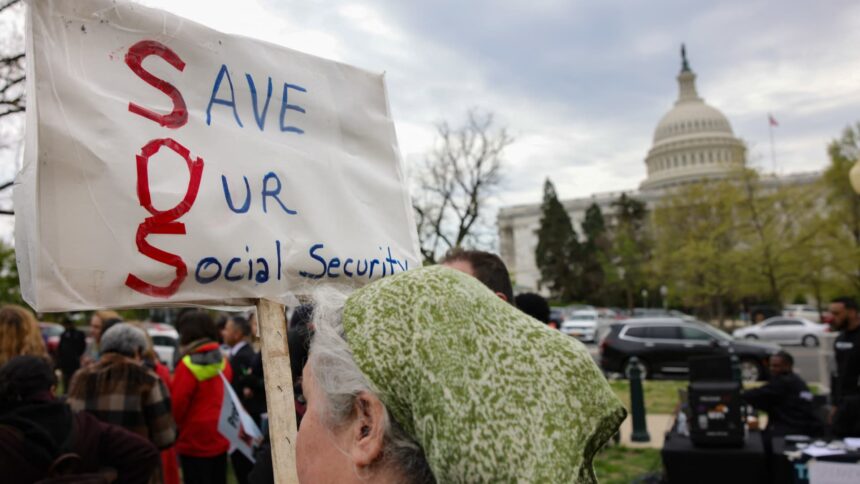
Washington lawmakers are facing an urgent timeline to address the solvency of Social Security’s retirement trust fund, according to a recent annual report from the program’s trustees. The Old-Age and Survivors Insurance (OASI) trust fund is anticipated to be depleted by the fourth quarter of 2032, with projections indicating that only 78% of benefits may be payable at that time. This timeline marks a shift, with the new projections arriving several months ahead of prior estimates, prompting fresh discussions on how to ensure the program’s longevity.
In response to the pressing situation, there has been a resurgence in proposals to increase taxes on the wealthy as a means to bolster Social Security’s finances. On Tuesday, Senators Elizabeth Warren and Bernie Moreno co-authored an op-ed detailing their collaborative efforts to legislate an increase in the payroll tax cap, a necessary step in enhancing the program’s fiscal health. Presently, earnings up to $184,500 are subject to Social Security payroll taxes; however, high earners cease contributing to the fund once they reach that threshold. For instance, data shows that individuals with $1 million in annual earnings stopped paying Social Security payroll taxes in 2026, which has raised alarms about the fund’s sustainability.
During a Senate Finance subcommittee hearing focused on the future of Social Security, Senator Bernie Sanders emphasized the need for the wealthiest in the country to contribute their fair share in taxes. He presented the Social Security Expansion Act, which he co-sponsored with Warren and other Democratic senators. This legislation seeks to increase taxes on earnings over $250,000 while also proposing benefit enhancements.
Another significant proposal from Representative John Larson, the Social Security 2100 Act, aims to extend payroll tax coverage to income over $400,000, also featuring benefit increases. Although introduced in 2023, that bill has not been reintroduced in the current session; however, it previously garnered 189 Democratic co-sponsors. Larson noted that Moreno’s involvement in discussions signifies a substantial breakthrough in forming a coalition to address Social Security’s challenges.
The existing payroll tax cap is adjusted annually to reflect national wage growth. This means that the disconnect between the cap and potential thresholds for reapplying payroll taxes—whether at $250,000 or $400,000—will inevitably narrow over time.
A review of past reforms shows that changes made in 1983 were initially aimed at ensuring a 75-year solvency for Social Security, projected to last until 2058. However, this timeline has been shortened, largely due to rising income inequality and the impact of the Great Recession. According to Stephen Nuñez, a director at the Roosevelt Institute, the payroll tax cap, which once covered a significant portion of eligible earnings, has diminished over the years, leading to reduced program revenue.
Debates continue regarding the implications of raising the payroll tax cap on the program’s financial health. Nancy Altman, president of Social Security Works, emphasized the importance of evaluating what level of benefits should be provided. She noted that current benefits are insufficient and that reducing them would negatively impact retirees and the economy. Concerns have also been raised about how proposed tax increases might affect small businesses, particularly pass-through entities whose profits are taxed on personal returns. Senator Sanders assured that his bill would exempt most small business owners from extra taxes under the proposed threshold.
Despite the proposals on the table, lawmakers face challenges in achieving bipartisan support. Senate Finance subcommittee chair Chuck Grassley highlighted the enormous unfunded obligations of the Social Security program, estimated at $30 trillion, and cautioned that simply increasing taxes on the wealthy or cutting waste would not suffice to remedy the fiscal shortfall.
Shai Akabas of the Bipartisan Policy Center reiterated the necessity for bipartisan cooperation, given that comprehensive Social Security reform requires 60 Senate votes to pass. He concluded that while increasing the taxable maximum should be a component of broader reform, it must be part of a balanced approach addressing revenues and potential benefit adjustments to navigate the financial complexities surrounding the program.