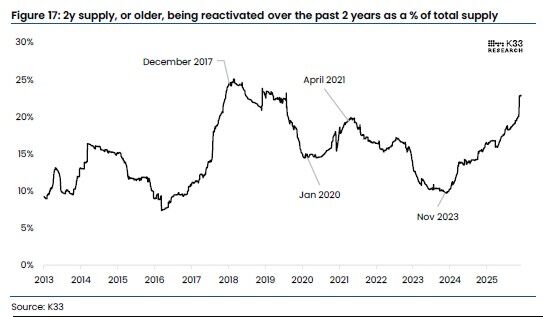
Bitcoin’s long-standing investors are increasingly cashing out, contributing to the cryptocurrency’s notable decline. Following a record high exceeding $126,000, Bitcoin has experienced a nearly 30% drop, with persistent selling pressures from long-term holders becoming evident. Recent blockchain data reveals a significant divestment of coins held for more than two years, indicating a sustained trend of selling among these investors.
According to a report from K33 Research, approximately 1.6 million Bitcoin, valued at around $140 billion, has been moved since the start of 2023. This trend has accelerated in 2025, with nearly $300 billion worth of Bitcoin that had been dormant for over a year returning to circulation. Blockchain analytics firm CryptoQuant reported that last month witnessed some of the highest distributions from long-term holders in more than five years.
Chris Newhouse, director of research at Ergonia, noted that the market is experiencing a gradual decline marked by steady selling into a thinner liquidity environment, making the current situation more challenging to reverse compared to past leverage-driven sell-offs.
Previously, the market benefited from robust demand from newly established exchange-traded funds (ETFs) and crypto investment firms, which helped absorb selling pressure. However, this demand has declined, with negative ETF flows and reduced derivatives volumes contributing to a cooling retail interest. The influx of Bitcoin onto a market with fewer active buyers has heightened concerns.
The situation worsened after October 10 when $19 billion in liquidations were recorded following unexpected comments regarding punitive tariffs from U.S. President Donald Trump, marking the largest single-day leverage washout in crypto history. Since this crash, traders have largely retreated from derivatives markets, showing few signs of a rebound.
After a momentary rise to $90,000, attributed to the liquidation of short positions, Bitcoin swiftly resumed its downward trajectory. The cryptocurrency fell as much as 2.8% to approximately $85,278, reverting back toward the lower end of its trading range since the October crash.
K33 Senior Analyst Vetle Lunde pointed out that contrary to previous cycles, the recent reactivations of Bitcoin are not driven by altcoin trading or protocol incentives. Instead, they are fueled by deep liquidity from U.S. ETFs and treasury demand, allowing early investors to lock in profits at significant price points while lessening ownership concentration. The activity seen over the past two years marks the second and third-largest long-term supply reactivations in Bitcoin’s history, only eclipsed by events in 2017.
Current data from Coinglass indicates that open interest, or the number of outstanding contracts for Bitcoin options and perpetual futures, remains substantially lower than prior to the October crash. This decline suggests that many traders are still hesitant to engage in the market, especially given that these derivatives represent a significant portion of overall trading volumes in the crypto space.
Furthermore, the basis trade—profiting from price discrepancies between spot and futures markets—has become unprofitable for hedge funds. Nevertheless, Lunde speculated that the selling pressure from long-standing Bitcoin holders may soon reach a threshold, based on historical patterns of on-chain flows. He suggested that as around 20% of the Bitcoin supply has been reactivated over the last two years, the sell-side pressure is likely to diminish, with expectations that selling will taper off by 2026. This shift could pave the way for an increase in buy-side demand as Bitcoin transitions towards deeper institutional integration in the market.