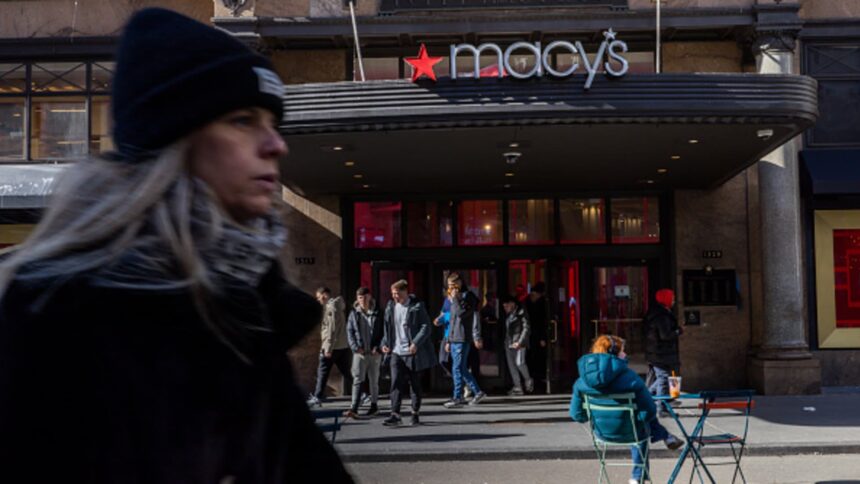
In a significant sign of progress, Macy’s has reported its strongest first-quarter comparable sales performance in four years. The department store chain, which is undergoing a comprehensive turnaround strategy, announced a 3% overall increase in comparable sales, with its flagship brand recording a 1.6% rise during the quarter. This robust performance is largely attributed to the 200 revamped stores that have been upgraded as part of Macy’s efforts to reinvigorate its offering.
Bloomingdale’s also saw impressive growth, achieving a 10.2% increase in comparable sales. This uplift was fueled by a selection of trendy brands and a distinctive “fun factor” that stands out in the luxury sector. The recent bankruptcy of rival Saks Fifth Avenue has, according to CEO Tony Spring, provided a boost to performance, although he emphasized that it is not the sole reason for the company’s growth.
Spring further elaborated on the company’s positive trajectory during an interview with CNBC, citing that better-than-expected sales and profitability have prompted an upward revision of Macy’s guidance for the full fiscal year. The retailer now anticipates net sales for 2026 to fall between $21.5 billion and $21.75 billion, surpassing earlier expectations of $21.59 billion. They project earnings per share to range from $2 to $2.20, an increase from the previous forecast of $1.90 to $2.10. Additionally, comparable sales growth is now expected to be between 0.5% and 1.2%, compared to the earlier guidance which predicted a decline to a slight increase.
A common trend among retailers this fiscal quarter has been strong growth, attributed in part to higher-than-usual tax refunds. Nonetheless, while Spring acknowledged the positive impact of tax refunds, he stressed that they were not the sole driver behind Macy’s growth. Encouragingly, the positive consumer trends observed in the first quarter have persisted into the second quarter, which Spring believes supports the revised guidance.
Despite a climate of macroeconomic and geopolitical uncertainty, he expressed confidence in the consistency of consumer behavior regarding their product categories. “We’re pleased with the second quarter to date and the breadth of the categories that are performing,” Spring commented, highlighting the steady demand across all three of Macy’s brands.
Macy’s latest financial results show a reported net income of $63 million, or 23 cents per share, for the quarter ending May 2. This marks a notable increase from the $38 million or 13 cents per share reported in the same quarter last year. On an adjusted basis, which factors in restructuring costs and one-time charges, earnings per share came in at 13 cents, slightly above Wall Street expectations.
Sales rose to $4.68 billion during the quarter, reflecting a 2% increase compared to $4.60 billion in the previous year. This growth comes as Macy’s embarks on a three-year turnaround plan directed by Spring, where the focus has been on revitalizing the business by closing underperforming stores, particularly in areas with failing malls, and investing in those that remain operational. This strategic approach emphasizes fundamental retail practices, including ensuring adequate staffing, creating enjoyable shopping experiences, and stocking desirable products.
Spring succinctly summarized the company’s renewed focus: “We’re not doing the fancy stuff, we’re doing the stuff that makes the biggest difference in the business.” He reinforced the importance of product quality and customer service, suggesting that consistent efforts in these areas have led to the positive results Macy’s has been experiencing.