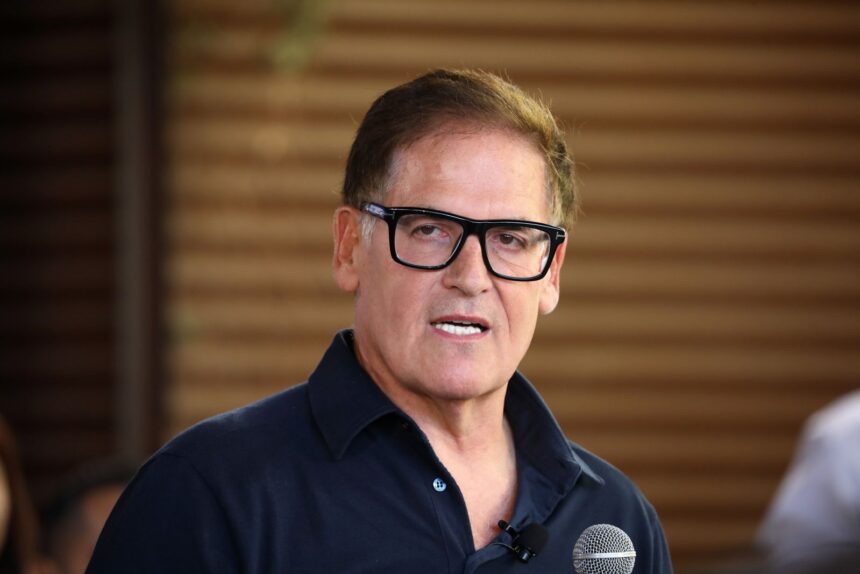
Elon Musk recently reached a remarkable financial milestone, as SpaceX successfully completed its long-anticipated initial public offering (IPO), pushing his net worth past the $1 trillion mark. This achievement reignited a familiar discussion regarding the nature of wealth among billionaires. Mark Cuban, the billionaire entrepreneur and investor, took to social media to assert a different perspective on the topic. He emphasized that Musk’s vast fortune is a direct result of millions of Americans’ desires to invest in the stock market.
In a post on X, Cuban remarked, “The reason anyone gets insanely rich is almost always because of the stock market,” highlighting a broader narrative about how wealth accumulation is intricately tied to the financial participation of the American populace. He indicated that billionaire fortunes are not merely products of individual success but are closely connected to the decisions made by average investors.
Cuban noted that approximately 150 million Americans own stocks, whether directly through brokerage accounts or indirectly via retirement plans, mutual funds, and exchange-traded funds (ETFs). He pointed to statistics showing that 58% to 62% of U.S. adults hold some form of stock ownership. For many, stock investments are a quiet part of their financial strategy, facilitated through vehicles like 401(k)s, IRAs, and pension plans, which have become vital for wealth accumulation over time.
Cuban underscored the importance of recognizing these dynamics in discussions surrounding billionaire wealth. He noted that roughly 60% of adults believe that high-profile billionaires, like Musk, could contribute to their financial well-being and overall prosperity.
While acknowledging the uneven distribution of stock market wealth—where the top 10% of Americans hold around 87% to 90% of total stock value—he maintained that market participation is still significant among the general population. Federal Reserve data confirms that stocks constitute about one-third of U.S. household financial assets. The number of families directly owning individual stocks may be around 21%, but this figure rises markedly when retirement accounts and funds are taken into account.
Cuban’s observations paint a nuanced picture of the risks involved in any substantial shift away from stock ownership. He warned that if a mass sell-off of stocks were to occur, it wouldn’t merely impact the wealth of billionaires like Musk but would devastate the savings of millions of everyday investors. This hypothetical situation could lead to catastrophic outcomes for the economy as a whole.
Reflecting on the aftermath of the 2008 financial crisis, Cuban noted that stock ownership among Americans dipped to approximately 52%. However, market participation has since rebounded alongside the expansion of retirement investing and a surge in popularity for low-cost index funds.
Cuban’s comments also serve to highlight how public markets are instrumental in creating wealth. Before SpaceX’s IPO, the company was perceived as a risky venture tasked with reinventing an industry traditionally influenced by government and defense contractors. Early investors took significant risks by backing Musk’s vision, ultimately being rewarded as the company flourished.
Today, investors continue to seek out transformative opportunities in cutting-edge fields such as artificial intelligence, robotics, and biotechnology. Despite the inherent risks—in which not all ventures will succeed—the reality remains that billionaire fortunes often arise from millions of investors pursuing what they believe to be valuable opportunities.
Ultimately, while the stock market may create striking wealth at the highest levels, it also offers millions of Americans a pathway to retirement security and long-term financial stability. Cuban’s perspective emphasizes that the narrative is not solely about figures like Musk; it’s also about the collective actions of investors who contribute to creating that wealth while working to build their own financial futures.