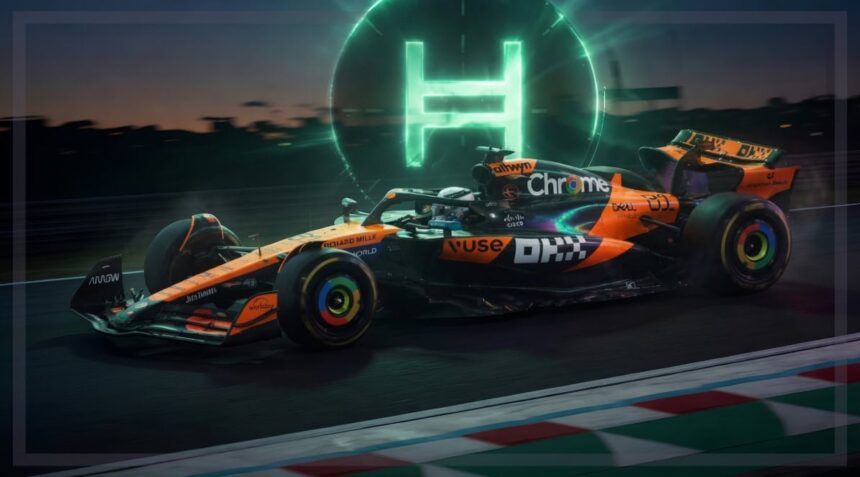
On March 25, 2026, McLaren Racing, a prominent name in Formula 1 and two-time reigning constructors’ champion, made headlines by joining the Hedera Council as a full governing member. This move places McLaren alongside established giants like Google, IBM, Boeing, and FedEx, holding equivalent voting rights within the 31-member council that spans 11 industries. Notably, McLaren’s involvement is not driven by advertising fees; rather, it signifies a transition to an operational role in the management of a network issuing the HBAR token.
The Hedera Council comprises organizations that contribute to running network nodes and approving critical software updates. This structure creates an environment where no single entity can dominate decision-making, illustrating a unique blend of interests—from high-octane motorsport to enterprise technology underpinning banking, telecommunications, and logistics.
While the world of Formula 1 is often characterized by technological advancements in aerodynamics, McLaren’s entry into blockchain governance showcases a strategic pivot toward digital innovation. The racing powerhouse, already a global sporting icon with a vast viewer base across more than 180 countries, aims to leverage its position to guide Hedera’s development while enhancing the fan experience through secure, digital offerings.
Earlier in January 2026, Hedera cemented its relationship with McLaren by signing a multi-year partnership, establishing itself as an official partner in both Formula 1 and IndyCar racing. The partnership kicked off with the introduction of free-to-claim digital collectibles during racing weekends, which McLaren has successfully launched during races in Australia, China, and Japan. These collectibles cater not only to crypto enthusiasts but also to fans using traditional social media sign-ins, broadening the reach of Web3 initiatives.
McLaren’s Co-Chief Commercial Officer, Nick Martin, articulated the strategic importance of the council seat. He emphasized the dual benefits: shaping the evolution of the Hedera network while ensuring a more robust and secure experience for fans globally. With McLaren’s extensive audience, combined with Hedera’s efficient transaction settlement capabilities, both entities stand to gain significantly.
From an environmental and social governance (ESG) perspective, McLaren’s collaboration with Hedera emerges as a particularly noteworthy aspect. The racing team is an active participant in the UN Sports for Climate Action Framework and has set an ambitious goal of achieving net-zero emissions by 2040, supported by targets verified by the Science Based Targets initiative. In its pursuit of sustainable practices, McLaren has already made strides in reducing its emissions, as highlighted by a report from Ditchcarbon that indicated a reduction in CO2-equivalent emissions from approximately 63,000 tonnes to around 57,600 tonnes year-on-year.
The collaboration between McLaren and Hedera provides a distinctive opportunity to address the intricacies of carbon tracking within the supply chain. Leveraging data-driven insights, McLaren has implemented an automated circularity platform that evaluates the sustainability of materials used in its operations. Meanwhile, Hedera promotes itself as a carbon-negative platform, boasting extremely low energy consumption per transaction and actively purchasing carbon offsets. Their open-source Guardian framework is designed to log emissions and other ESG metrics in an immutable manner, which could align with McLaren’s sustainability ambitions.
However, it is important to note that despite the alignment of ESG goals, neither McLaren nor Hedera has launched any specific emissions-tracking product as of mid-2026. While the potential is clear, the practical application remains in the pipeline.
For McLaren, being part of the Hedera Council brings not just governance influence but also early access to fan-focused digital applications, alongside association with a low-energy blockchain partner that complements its sustainability narrative. On the other hand, Hedera benefits from the affiliation with one of the most recognized names in sports, diversifying its focus beyond traditional enterprise clients.
Despite these developments, the market performance of HBAR, Hedera’s native token, does not reflect the potential changes. As of early June 2026, HBAR was trading at approximately $0.085, significantly lower than its prior peak of $0.569 in September 2021. The persistent volatility of the HBAR token demonstrates a disconnection between new governance and partnerships and the token’s market trajectory.
As enterprise blockchain moves toward greater accountability and verifiable ESG data amid tightening regulations, McLaren’s engagement with the Hedera Council signals a noteworthy shift in navigating these complexities. However, the optimistic governance narrative does not equate to an immediate price catalyst for HBAR, marking a clear delineation between the evolving blockchain ecosystem and token valuation.