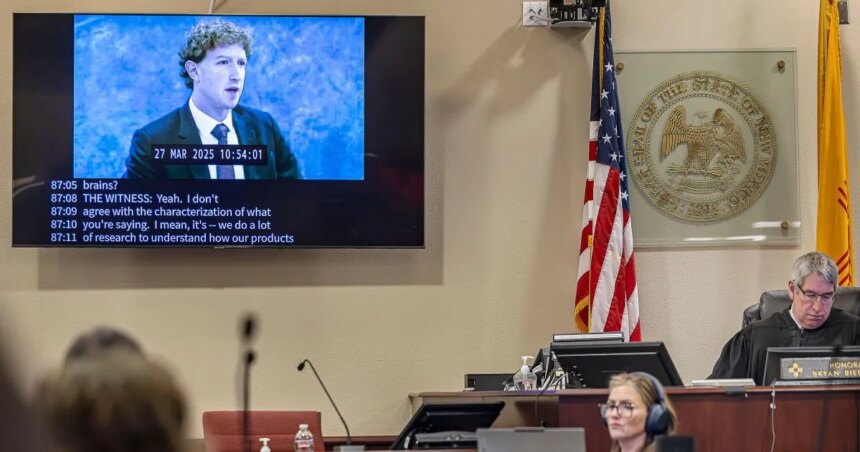
A jury in New Mexico has mandated that Meta, the parent company of Facebook, Instagram, and WhatsApp, pay $375 million for damaging children’s mental health and exposing them to sexual exploitation. This verdict marks a significant milestone, as it is the first instance of a US state successfully suing the tech giant over child safety issues.
The decision came after a six-week trial wherein state officials accused Meta of neglecting its responsibility to safeguard minors on its platforms. Jurors were persuaded by state prosecutors’ assertion that the company prioritized profits over safety, thus breaching certain provisions of New Mexico’s Unfair Practices Act. The jury found that Meta had engaged in false or misleading practices and acted in ways that unfairly leveraged the vulnerabilities and naivete of children.
Court proceedings included testimonies from 40 witnesses, including whistleblowers, alongside the examination of numerous documents, reports, and emails. In response to the verdict, a Meta spokesperson expressed disagreement and indicated plans to appeal, stating, “We work hard to keep people safe on our platforms and are clear about the challenges of identifying and removing bad actors or harmful content.”
New Mexico Attorney General Raúl Torrez, who led the charge against Meta, described the verdict as a landmark win for children and families affected by the company’s prioritization of profit over safety. He highlighted that the jury’s decision should send a strong message to the technology industry that accountability extends to all companies, regardless of their influence.
The case followed an undercover operation conducted by Torrez’s office, where investigators pretended to be users under the age of 14 on Facebook and Instagram. The operation revealed that these fake accounts were targeted with sexually explicit material and approached by adults seeking to engage in inappropriate interactions, leading to several criminal charges.
Looking ahead, a second phase of legal proceedings against Meta is set to commence in May, during which a judge will assess whether the company should face further penalties and be mandated to implement specific operational changes aimed at enhancing the safety of its platforms for children.
In addition, another jury in California is currently deliberating on whether Meta and YouTube should be held accountable for the negative impacts suffered by children on their platforms due to addictive features. This case is seen as a potential bellwether that could set precedents influencing numerous similar lawsuits involving social media companies across the United States.