In a remarkable move, Strategy (MSTR), the largest publicly traded holder of bitcoin, disclosed its recent acquisition of 4,871 BTC, amounting to a substantial $330 million. This purchase represents one of the company’s largest investments in the current year, 2026. However, a puzzling trend has emerged: substantial buys like this often do not catalyze upward movements in bitcoin’s market price. In fact, there is a tendency for bitcoin’s value to dip following such announcements.
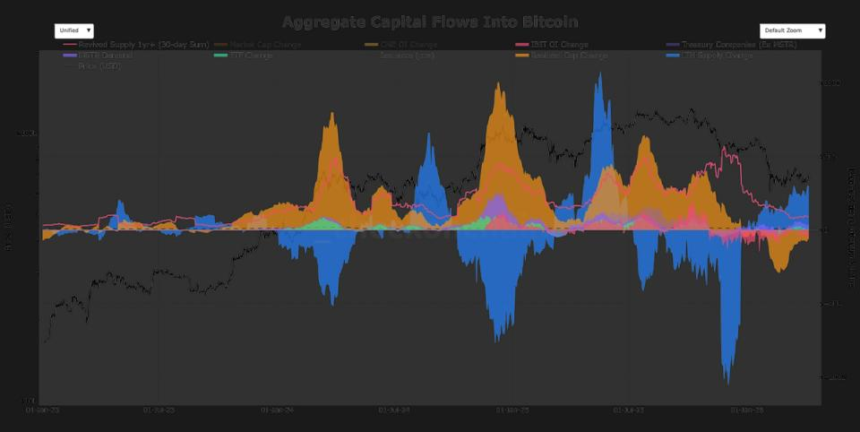
To grasp this phenomenon, one must delve into the dynamics of market flows. MSTR’s demand only constitutes about 7% of total gross inflows into bitcoin, a figure that increases to approximately 9% when considering net flows. Gross flows represent new capital entering the market, while net flows account for both the buying and selling sides, providing a clearer view of the overall market pressure.
Despite Strategy’s consistent purchases, their influence on the market appears limited compared to more significant forces at work. Historically, MSTR’s footprint was far more impactful. Back in November 2024, the company’s demand had skyrocketed to over $15 billion, coinciding with its peak stock price and bitcoin surpassing the $100,000 mark. However, recent activity has stabilized to between $1 billion and $4 billion, with the latest demand hovering around $2.8 billion in the past month.
The primary market drivers currently are long-term holders (LTHs)—bitcoin that has been in possession for more than 155 days. These holders are responsible for an impressive $28.5 billion in supply changes. Among this group, a particular focus is on the revived 1+ year supply, representing older coins that have moved on-chain recently, which adds about $9 billion in changes.
In contrast, U.S. spot exchange-traded funds (ETFs) have contributed approximately $1 billion in inflows within the last month, while ongoing miner issuance is equating to 450 BTC each day, creating an additional monthly supply pressure of around $880 million.
Crucially, the capital landscape remains in flux, with a significant drawdown of $29 billion from bitcoin’s realized cap since February, alongside a drop of over $4 billion in BlackRock’s IBIT open interest. These substantial outflows overshadow MSTR’s demand and reflect a broader trend of capital being withdrawn from the market.
Although Strategy continues to add to its bitcoin reserves, the overwhelming supply distributed by other market participants and the continuing capital outflow is stifling any potential price increases. The overall environment suggests that even substantial acquisitions by major players may struggle to affect the marketplace in the current economic climate.