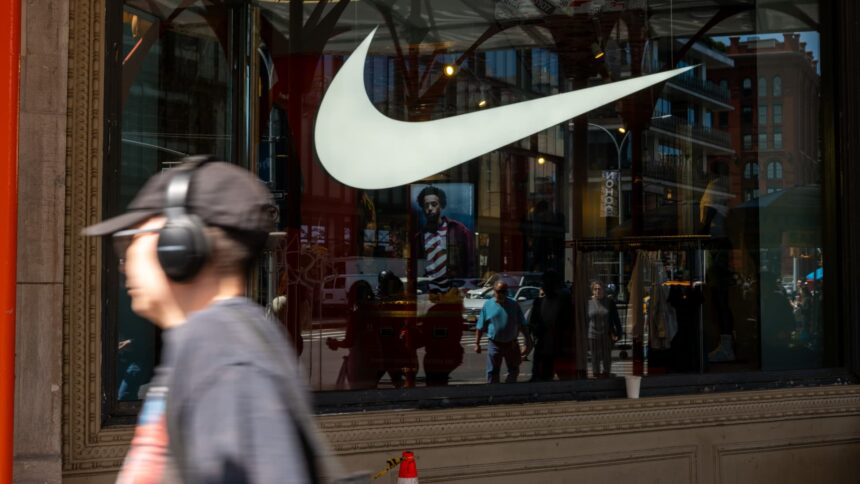
The iconic Nike swoosh design recently adorned the window of the company’s newest store on Broadway in Manhattan, marking a significant moment in their retail expansion. As Nike gears up to report its fiscal fourth-quarter results, the company faces ongoing challenges in its efforts to regain sales growth under the leadership of CEO Elliott Hill.
In its prior communications, Nike indicated that sales would continue to decline for the remaining calendar year. The company projected a drop of 2% to 4% for the fiscal fourth quarter, which contrasts sharply with Wall Street’s expectations of a modest increase of 1.9%. Despite the downturn, Nike revealed an unexpected boost from tariff refunds that hadn’t been included in earlier projections.
According to Chief Financial Officer Matt Friend, future sales are anticipated to decline by a low single-digit percentage for the remainder of the calendar year. While North America is expected to show some growth, declines in the significant Chinese market could offset these gains. Last quarter, Nike’s gross profit margin faced pressure due to increased tariffs in North America.
In the fiscal third quarter, Nike reported a 3% increase in sales within North America, while revenue from greater China fell by 7%, totaling $1.62 billion. Analysts are projecting earnings of 13 cents per share for the upcoming fiscal fourth quarter and anticipate revenue of approximately $10.86 billion. For the entire fiscal year, expected revenue stands at $46.27 billion, with predictions of $46.47 billion for the fiscal year ending in May 2027.
Recognizing the complexities of their situation, Hill has been working to reposition Nike to encourage future growth amidst declining sales. He acknowledged that the turnaround would be non-linear, with various segments improving at differing rates. During recent earnings calls, he indicated that some of the initially targeted business areas are beginning to show positive momentum.
These efforts coincide with broader economic uncertainties, including rising tariffs, geopolitical tensions, and fluctuating oil prices, all of which threaten consumer confidence. Friend emphasized the company’s focus on aspects they can control while acknowledging the unpredictability of external factors.
In a bid to streamline operations, Nike recently announced a significant workforce reduction, laying off 1,400 employees, marking its second such move this year. Additionally, a change in leadership is on the horizon, with former Pfizer executive David Denton set to replace Friend as CFO starting August 17.
Despite these challenges, Nike has found a silver lining in its marketing efforts surrounding the World Cup, which is taking place across North America this summer. Although not an official sponsor, the brand has seen its advertisements outperform competitor Adidas, gaining significant traction on social media platforms.
Following the release of their earnings, Nike will host a conference call with analysts at 5 p.m. ET, emphasizing their ongoing commitment to transparent communication regarding their performance and strategy moving forward.