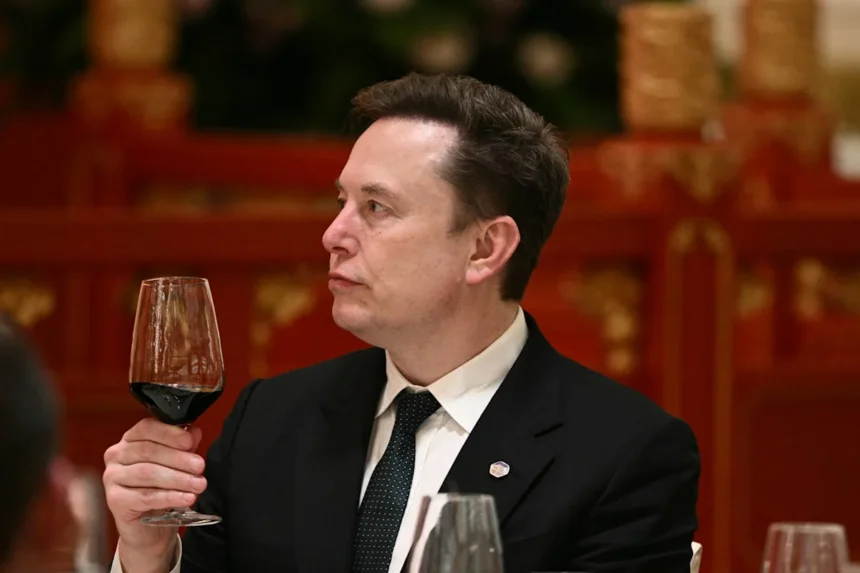
On June 12, the crypto community’s attention was captured by SpaceX’s public debut, particularly due to its substantial holdings in Bitcoin. As of March 31, the company reported 18,712 Bitcoin on its balance sheet, making it one of the largest public companies to invest heavily in the leading cryptocurrency. SpaceX, often seen as Elon Musk’s ambitious endeavor, is viewed by many in the crypto sector as a proxy for Bitcoin itself. Musk, known for his enthusiastic support of various cryptocurrencies, has influenced market sentiment significantly.
However, not all observers share the optimism surrounding SpaceX’s massive initial public offering (IPO), which has effectively made Musk the world’s first trillionaire. Renowned economist Paul Krugman has voiced skepticism about SpaceX’s high valuation, which reached $2.75 trillion on June 17. In a blog post, Krugman pointed out the stark contrast between SpaceX’s $4.9 billion loss against its $18.7 billion in revenue the previous year compared to established tech giants like Microsoft that consistently report profits.
Krugman attributes the inflated valuation to investor faith in Musk’s charisma, dubbing him a “wizard,” and suggested that this trust may stem more from his political influence—having close ties with former President Trump—than from tangible technological advancements. He raised concerns about how much the perceived “favoritism” could actually yield in terms of valuation.
Drawing parallels between SpaceX and Bitcoin, Krugman noted that while Trump had once dismissed Bitcoin as a “scam,” his eventual support during the 2024 presidential campaign led to an unprecedented surge in Bitcoin’s value, reaching an all-time high of $126,080 in October 2025. He pointed out that Bitcoin’s valuation at that peak was nearly equivalent to SpaceX’s, suggesting both entities thrive on speculative sentiment rather than robust economic fundamentals.
However, Bitcoin’s value plummeted during the October 10 “flash crash,” triggered by political tensions stemming from Trump’s threats of tariffs on China. Krugman characterized this chaotic market behavior as a “Trump trade,” emphasizing that the cryptocurrency’s fluctuations were politically motivated rather than driven by economic factors. As Trump’s popularity waned, so too did Bitcoin’s value, leading to considerable financial losses for those who bought into the speculative frenzy.
Krugman, who has long been critical of Bitcoin, has argued that its valuation is supported more by its allure than by any intrinsic utility, likening its trajectory to a bubble akin to the housing crisis. While he acknowledged that SpaceX has a profitable segment in Starlink, he believes that only extraordinary growth in that division could justify its lofty valuation. He is skeptical, predicting that like Bitcoin, early investors in SpaceX may profit only as long as they exit before market conditions falter.
In his conclusion, Krugman labeled SpaceX a “meme stock,” reinforcing the idea that its current value is buoyed more by hype and social media sentiment than by financial performance. SpaceX’s share price recently closed at $185, granting the company a valuation exceeding $2.40 trillion, while Bitcoin traded at around $62,498, with a market capitalization of $1.25 trillion. This snapshot of the cryptocurrency’s and space company’s market dynamics raises questions about the sustainability and rationale behind such large valuations.