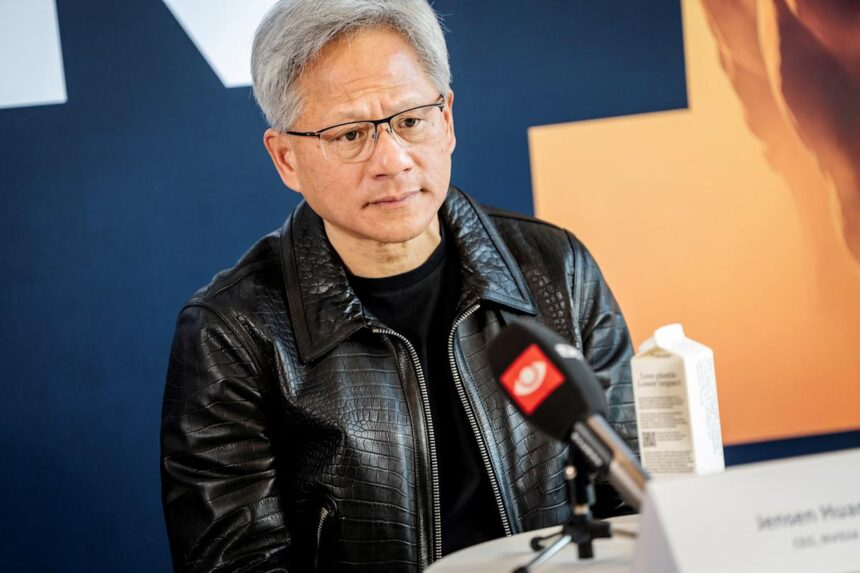
In a striking revelation, Jensen Huang, CEO of Nvidia, indicated that the company’s market share in China has dwindled to zero, a stark contrast to its previous dominance. During an appearance on the Special Competitive Studies Project’s Memos to the President, Huang discussed the implications of current US-China trade policies on Nvidia’s business prospects. He highlighted that the company once commanded a significant portion of the global market, asserting that it held “90-some odd percent” of market share worldwide, particularly in the semiconductor sector.
The fluctuating US policies concerning the export of semiconductor technologies to China, including high-powered chips from Nvidia and competitor AMD, have had a profound impact on the market landscape. While there have been indications from former President Trump about permitting certain shipments of Nvidia’s H200 chip, Commerce Secretary Howard Lutnick remarked that no shipments have been made thus far.
Concerns surrounding the potential military applications of these chips have led to skepticism among policymakers about renewing sales to China. Opponents fear that enabling access may inadvertently assist China’s military efforts in developing artificial intelligence systems that could pose a threat to the U.S.
In contrast, Huang argues that it would be strategically unwise to forfeit access to a market as vast as China. He emphasized that a strict exclusion might accelerate China’s push to create its own competitive AI processors, simplifying its ambition to become self-sufficient in technology. Huang noted, “Conceding an entire market the size of China probably doesn’t make a lot of strategic sense,” and suggested that the current policy approach is lacking in adaptability to the evolving technological landscape.
Nvidia’s recent financial disclosures paint a concerning picture of its revenue streams from China, which, including Hong Kong, totaled $19.67 billion in the last fiscal year. However, the company is not optimistic about future revenues, projecting no earnings from the Chinese market in its upcoming quarter. Despite having secured a license in February to export the H200 chip, Nvidia remains uncertain about its ability to sell products in China and whether it will receive the necessary import licenses.
In its 10-K filing, Nvidia expressed serious concerns over its competitive stance in China’s data center market. The company noted that being effectively shut out has allowed competitors to expand their developer and customer ecosystems, posing a significant challenge for Nvidia’s global operations. It remarked, “Unless we are able to return with a product that meets the approval of both the [US government] and the Chinese government, our lost opportunity and the benefit to our competitors will have a material and adverse impact on our business, operating results, and financial condition.”
As the semiconductor landscape continues to evolve, the implications of such trade restrictions will likely resonate throughout the industry, influencing both corporate strategies and geopolitical dynamics.