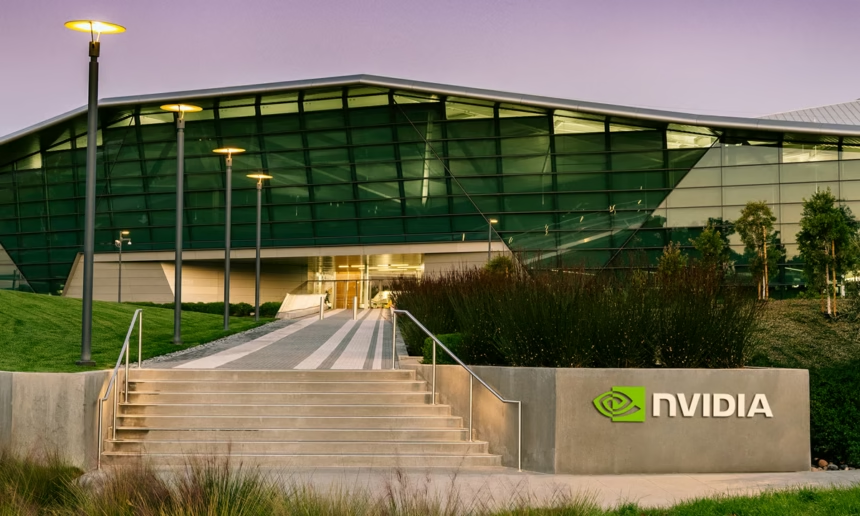
Nvidia has emerged as a frontrunner in the rapidly growing field of artificial intelligence (AI), driven by the soaring demand for its graphics processing units (GPUs). Originally designed for enhancing video game graphics, these chips have become crucial in AI applications, propelling Nvidia into a position of dominance and resulting in a staggering 1,150% increase in its stock value since the beginning of 2023. The ascent has been met with mixed sentiments as discussions on Wall Street and Main Street continue about the stock’s future trajectory.
Understanding Nvidia’s journey requires an appreciation of its versatility in adapting GPU technology for various tasks. The company has effectively leveraged its expertise in parallel processing—a method that speeds up complex computational tasks by dividing them across multiple processor cores. This capability has not only advanced AI but has also solidified Nvidia’s market position.
As AI grows increasingly reliant on data centers for processing power, Nvidia has captured a substantial 92% share of this market. The current surge in data center construction reflects the escalating demand for AI infrastructure, which McKinsey & Company estimates will require nearly $7 trillion in investment by 2030.
At Nvidia’s recent GPU Technology Conference, CEO Jensen Huang outlined a remarkable growth forecast, predicting future revenues exceeding $1 trillion from its upcoming Blackwell and Vera Rubin chips by the end of 2027. Huang expressed confidence in the company’s backlog and anticipated increased computing demand, stating, “We are going to be short.”
The financial prospects for Nvidia appear robust. Based on Huang’s assertions, one can project potential revenues from Q1 forecasts and current market conditions. Currently, Nvidia expects to generate around $922 billion in revenue over the next 21 months, which translates to a targeted growth rate of approximately 13% sequentially over seven quarters. Should this ambitious goal be met, Nvidia could achieve revenues of about $379 billion in fiscal 2027.
Given Nvidia’s market cap of roughly $4.42 trillion and a price-to-sales (P/S) ratio of around 21, maintaining these metrics could potentially elevate the stock price to $322 per share, marking a 77% increase and pushing the company’s market cap to approximately $7.8 trillion.
However, the numbers come with caveats. The industry is witnessing the emergence of competitors offering rival GPUs and Application-Specific Integrated Circuits (ASICs) that may challenge Nvidia’s market dominance. Furthermore, unforeseen economic shifts or overly optimistic projections about AI adoption could impact these forecasts.
Despite the uncertainties, Nvidia is currently valued at about 22 times forward earnings, suggesting it remains reasonably priced amidst its impressive growth prospects. Analysts note the company’s ability to consistently outperform expectations and capitalize on favorable market trends, solidifying its attractiveness as an investment choice.