Oil prices surged by more than 5% and Asian shares experienced gains on Monday, driven by escalating tensions between Iran and the United States, which hindered tankers’ access to the critical Strait of Hormuz.
The Persian Gulf waterway experienced renewed closures after Iran reversed an earlier decision to reopen it. In response, U.S. President Donald Trump reiterated that a Navy blockade of Iranian ports remains firmly in place, escalating concerns regarding the stability of oil supply routes.
U.S. benchmark crude prices increased by 5.6% to $87.20 per barrel, while Brent crude, regarded as the international standard, saw a 5.3% rise, reaching $95.16 per barrel. These developments have cast doubts on how soon oil shipments will resume from this vital region, which supplies significant amounts of oil to the global market.
Despite these concerns, shares in Asia mostly advanced. The Nikkei 225 in Tokyo climbed 1% to finish at 59,045.45, while South Korea’s Kospi surged 1.1% to close at 6,260.92. The Hang Seng index in Hong Kong registered a gain of 0.8%, rising to 26,373.71, and the Shanghai Composite index increased by 0.6%, settling at 4,075.08. Australia’s S&P/ASX 200 remained relatively stable, finishing almost unchanged at 8,943.90, while Taiwan’s Taiex jumped 1.4%.
Market experts offered a cautious assessment of the ongoing volatility. Stephen Innes of SPI Asset Management pointed out that the challenge for investors lies in the overestimation of positive market sentiments rather than a lack of hope. He suggested that recent upward movement in stock prices feels more like momentum rather than conviction.
The previous week had seen oil prices plummet back to their levels from the early days of the Iran conflict, following an announcement from Iran signaling that the strait was open for commercial oil tankers. Such a development could ease pressure on fuel prices and, potentially, alleviate some financial burdens for consumers regarding credit-card interest and mortgage bills.
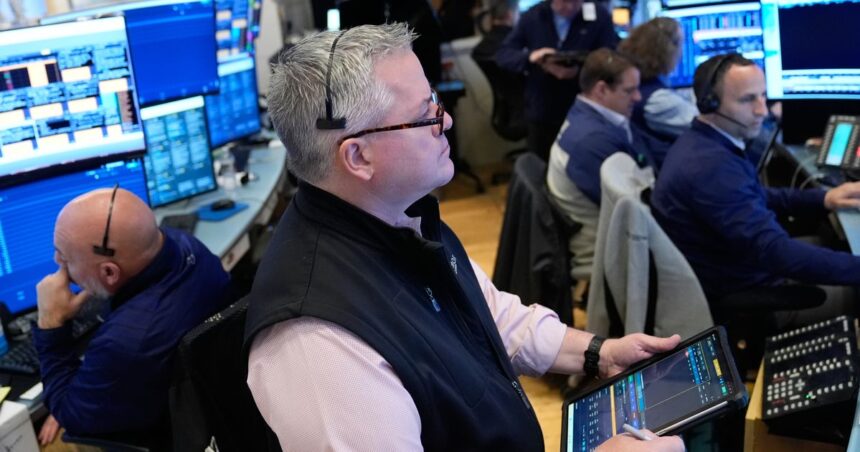
On the U.S. stock market front, the S&P 500 surged by 1.2%, reaching a historic high of 7,126.06, marking its third consecutive week of substantial gains. Similarly, the Dow Jones Industrial Average soared by 1.8% to close at 49,447.43, with the Nasdaq composite climbing 1.5% to settle at 24,468.48. The American stock market has rebound by over 12% since hitting a low in late March, fueled by optimistic expectations that the U.S. and Iran may find a way to navigate the ongoing conflict without inducing severe global economic repercussions.
Interestingly, the rapid rise in stock prices followed a brief drop in oil costs, which had plummeted 9.4% after Iranian Foreign Minister Abbas Araghchi announced that the strait was “completely open” for commercial vessels, following a ceasefire in Lebanon. Brent crude had also dipped 9.1% on the same news. Nevertheless, Trump reaffirmed the U.S. Navy’s blockade, highlighting that it is in full effect pending a resolution to the conflict, while also indicating that negotiations could be expedited since many issues are reportedly already settled.
Tensions intensified further on Sunday when President Trump revealed the U.S. had confiscated an Iranian-flagged cargo ship attempting to circumvent the naval blockade. Iran’s military responded, vowing to retaliate and deeming the seizure an act of piracy.
As the temporary ceasefire between the U.S. and Iran approaches its expiration on Wednesday, escalating hostilities in the Strait of Hormuz raise urgent questions regarding future negotiations aimed at resolving the ongoing war. Since the conflict began, market sentiment has fluctuated widely between optimism and trepidation concerning the resolve of the fighting and its potential impact on the global economy, though strong earnings reports from major U.S. firms have bolstered investor confidence somewhat.
In currency markets, the U.S. dollar gained against the Japanese yen, rising to 158.90 from 158.79 yen, while the euro increased slightly to $1.1757 from $1.1742.