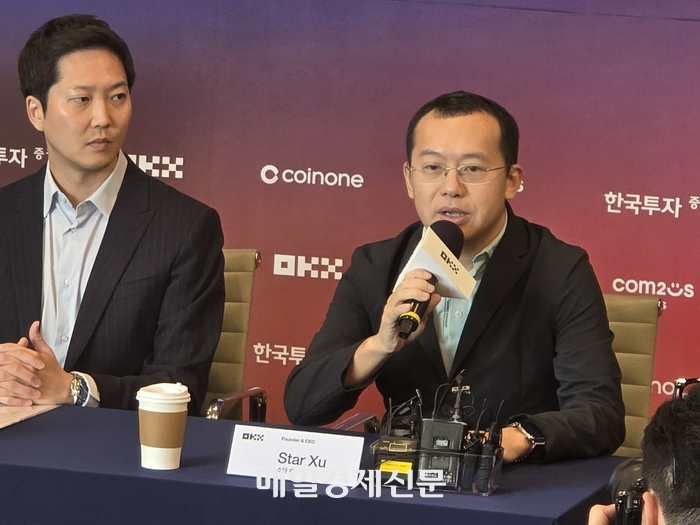
In a recent interview at Coinone headquarters, CEO Xu Mingxing of OKX, a top-tier virtual asset exchange, articulated the motivations behind their substantial investment in Coinone, Korea’s third-largest digital asset exchange. OKX Ventures, a subsidiary of OKX, invested approximately KRW 80 billion for a 19.6% stake, positioning it as a joint third-largest shareholder alongside Korea Investment & Securities.
Xu emphasized Korea’s maturity in the digital asset market and highlighted the synergy between OKX and Coinone, particularly in corporate culture and security. He praised Coinone’s security-first approach, established by CEO Cha Myung-hoon, a former white-hat hacker. This alignment with OKX’s foundational engineering principles was a key reason for the partnership.
The CEO characterized the investment as a long-term commitment to the Korean digital market, focusing on enhancing Coinone’s competitiveness through shared operational expertise, particularly in risk management and transaction capabilities. He outlined plans for cooperative initiatives, including sharing OKX’s advanced technology for large-scale transactions and real-time fraud detection.
Amidst increasing concerns over security, particularly with the rise of deepfake technology, Xu noted that OKX has implemented its own sophisticated systems to protect against such risks during customer verification processes. Furthermore, he stressed the importance of regulatory alignment and building trust with domestic authorities as a pathway to long-term growth in Korea.
Discussing the future landscape of digital finance, Xu pointed to opportunities arising from collaborations with traditional financial institutions, highlighting the potential for tokenizing blue-chip stocks. He expressed strong interest in facilitating access for global investors to major Korean firms such as Samsung and SK Hynix, breaking down existing barriers through blockchain technology.
The partnership with the Intercontinental Exchange (ICE), a major player in global financial infrastructure, was also underscored as a pivotal element in advancing OKX’s capabilities. ICE’s significant investment in OKX underscores the exchange’s competitiveness and signals future innovations in asset tokenization and market integration.
In light of ongoing developments, Xu mentioned the possibility of an initial public offering (IPO) but noted the importance of achieving a high level of transparency and regulation first. He stressed that any decision regarding a public listing would prioritize creating long-term value for shareholders rather than pursuing rapid financial gains.
OKX’s success in the virtual asset derivatives market is partly attributed to its robust technological infrastructure, which has remained reliable during market volatility. Xu asserted that asset security is paramount, and the exchange’s approach, which includes regular audits and a commitment to customer protection, is designed to bolster user trust.
Lastly, discussing the evolving definition of decentralization, Xu highlighted the necessity of transparency in transactions and the enduring principle that users should control their assets without undue interference from platforms. This philosophy reflects a broader vision for integrating AI and blockchain into a transformative asset management framework, fostering a more decentralized and user-centric financial ecosystem.