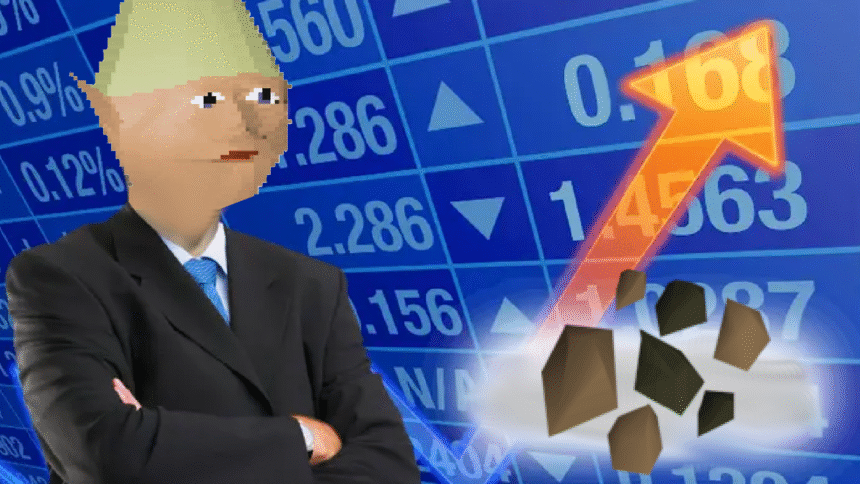
In a striking revelation about investment trends, recent data suggests that investing in Old School RuneScape (OSRS) bonds could have outperformed Ethereum, one of the most prominent cryptocurrencies in recent years. As cryptocurrency has been labeled as being in a “collateral death spiral” earlier this year, alternative investment routes are now drawing attention for their surprisingly lucrative potential.
According to Arkham, a platform that analyzes cryptocurrency trading metrics, OSRS coal—a resource in the game—has seen an approximate 40 percent increase in value, whereas Ethereum’s growth hovered in the low 30s. This information raised eyebrows, especially given Ethereum’s notoriety in the crypto market during the boom years of 2021.
In a hypothetical scenario where an investor purchased OSRS bonds and converted them into coal, one could have theoretically matched investments dollar-for-dollar with potential buyers in the game. By taking this route, one might have found a more stable return compared to the volatility of decentralized currencies such as Ethereum.
Coal in OSRS is utilized for various in-game functions, such as smelting bars, providing it with a continuous and reliable demand. This predictability stands in stark contrast to the risky landscape of cryptocurrency investments, where values can fluctuate dramatically based on market sentiment and external factors. One insightful commentator pointed out the peculiarities of comparing the two economies, suggesting that the intricate market dynamics of MMOs like RuneScape are perhaps more balanced and rational than traditional financial systems designed for the modern age.
The comparisons highlight not only the potential of alternative investment strategies but also cast doubts on the stability of cryptocurrencies as a safe long-term investment. While some individuals may still see potential in crypto, the case for OSRS coal underscores the importance of understanding market dynamics—whether in digital games or the unpredictable world of cryptocurrencies.
This economic curiosity invites further discussion about player-driven markets in online games and how they reflect broader economic principles. It turns out that some players are carving niches in video game economies akin to entrepreneurial ventures in real-world markets, managing to generate profits in ways that might seem unconventional but effectively utilize the rules of the game.