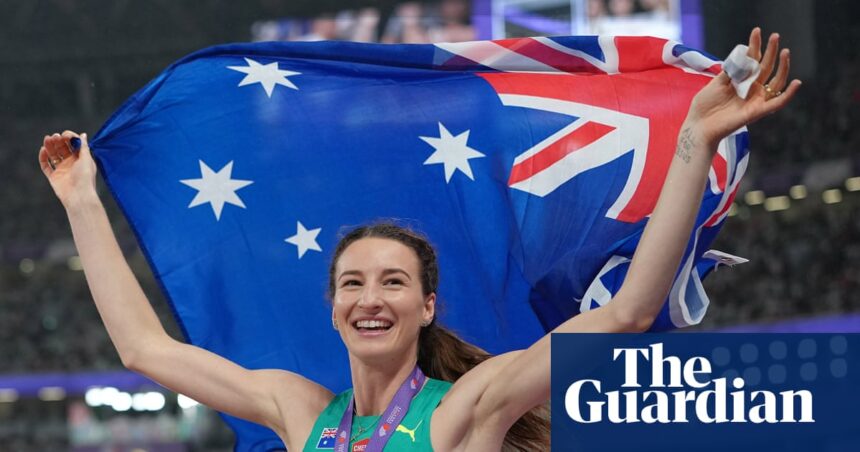
In a dramatic final evening at the World Championships in Tokyo, Nicola Olyslagers secured Australia’s first gold medal in high jump, clearing 2 meters to triumph over Poland’s Maria Zodzik based on a countback. Olyslagers’ impressive performance capped off a challenging night characterized by persistent rain delays that affected both the high jump and men’s discus events.
The conditions for the men’s discus competition were particularly chaotic, as heavy rain rendered the throwing circle dangerously slippery. This forced officials to pause the event, only to resume it late at night after the final track event concluded. In an effort to manage the situation, officials frantically employed towels to dry the circle, the discus, and athletes’ shoes. It wasn’t until past 11 PM that the rain finally relented, allowing the competition to continue. In a surprising turn of events, two late throws altered the standings, pushing Australian athlete Matt Denny out of podium contention. Sweden’s Daniel Ståhl ultimately claimed gold with a throw of 70.47 meters.
Denny expressed his frustration with the conditions, describing them as the worst he has experienced in competition. Following his performance, he had an emotional moment with his wife in the stands, reflecting on the disappointment of the evening. “It was just really hard, really emotional and disappointing,” Denny said, adding that a fall during the event hadn’t resulted in serious injury.
On the other hand, Olyslagers, who had already clinched the world indoor and Diamond League titles earlier in 2025, demonstrated exceptional resilience amid the weather challenges. After clearing 2 meters without a miss, she faced a lengthy wait for the next round, saying, “Even if [I was] waiting and out there in the rain, I have such a joy because I know these moments are forever.” Despite the weather, she relished the experience while leaning on her strong Christian faith during the delays.
Eleanor Patterson, another Australian high jumper, finished fifth after clearing 1.97 meters, tying with joint bronze medalists Yaroslava Mahuchikh and Angelina Topic but ultimately falling short on countback.
Earlier in the evening, Jess Hull took to the track in the 800 meters final, where she came just shy of equaling a national record. Despite finishing eighth behind Kenyan winner Lilian Odira, Hull expressed contentment in her performance and acknowledged the fierce competition in her first major global final.
In the 5000 meters, Ky Robinson delivered a commendable performance, finishing fourth, which marked Australia’s second-best result in this event at a world championship, following Craig Mottram’s bronze in 2005. Feeling a mix of joy and retrospect after crossing the finish line, Robinson reflected on the race, contemplating the narrow miss of a medal.
The night’s relays, however, proved disappointing for Australia. The men’s 4x100m team failed to finish due to a mishap in the baton exchange, adding to the earlier woes of the 4x400m team, which had been disqualified for a changeover area violation, along with the women’s 4x100m team which dropped the baton.
As the World Championships concluded, Australia finished 15th on the medal tally, securing one gold and three bronze medals. The United States dominated the event, finishing atop the medal count with 16 gold medals among 26 overall, followed by Kenya and Canada.