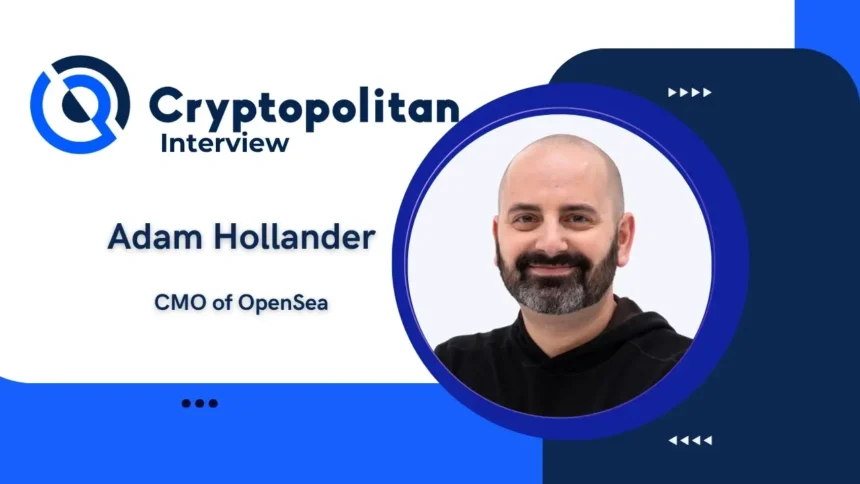
At Consensus Miami, OpenSea’s Chief Marketing Officer, Adam Hollander, outlined the company’s ambitious plan to transition from being solely an NFT marketplace to a comprehensive platform that encompasses various blockchain assets, including meme coins, perpetual contracts, and major cryptocurrencies. In an engaging interview with Karnika E. Yashwant, known as Mr. KEY, the founder and CEO of KEY Difference Media, Hollander highlighted the evolution of OpenSea and its new non-custodial app.
Hollander recounted his professional journey, beginning with the sale of a software company to Microsoft. He later served as Chief Operating Officer at a medical education firm before diving deeply into the NFT space as a collector and trader. His passion for digital ownership and the underlying technology ultimately led him to OpenSea a year ago, where he aims to reshape the user experience.
OpenSea aims to simplify crypto transactions for its users, allowing them to trade various digital assets across 26 chains without the cumbersome process of bridging. This new vision focuses on non-custodial ownership, catering to users who prefer to maintain control over their crypto assets rather than relying on closed platforms. Hollander remarked on the shift in user mentality observed during the NFT boom, noting that many buyers were primarily motivated by speculation rather than genuine appreciation for digital art or community engagement.
In response to questions about the platform’s recent overhaul, Hollander explained that OpenSea underwent a complete reorganization through OS2 to better support the broader range of assets now available. The foundational architecture of the old platform was insufficient to manage the complexity of new trading opportunities.
The upcoming OpenSea Mobile app is set to enhance accessibility for users, allowing them to create wallets in seconds and use Apple Pay for transactions. The app aims to empower users by enabling them to manage their finances effortlessly while maintaining the functionality for experienced traders.
In discussing user engagement, Hollander indicated that over a million wallets participated in OpenSea’s recent rewards program, although the initiative was turned off a month prior, suggesting sustained user interest outside of promotional incentives. Current users are primarily crypto-native, but the mobile app is geared toward attracting newcomers to the space.
With approximately 600 beta testers currently providing feedback on OpenSea Mobile, the company is keen on refining the product prior to its broader release. Hollander expressed confidence in OpenSea’s discovery system, emphasizing its ability to identify relevant on-chain behavior through NFTs, thus providing potent recommendations for users.
While the app’s initial release will not incorporate decentralized finance (DeFi) connections, Hollander recognized the future potential for integrating such features. For now, the focus remains on direct asset ownership rather than yield-generating protocols.
Addressing the competitive landscape, Hollander differentiated OpenSea from custodial products offered by banks and other platforms, reinforcing the value of user-owned wallets and the unique offerings related to NFTs and tokenized assets. He stressed the challenges faced by major custodial platforms in adequately supporting NFTs and confidently proclaimed, “Nobody can touch it with a 100-foot pole.”
Looking ahead, Hollander provided insight into OpenSea’s future, noting that the upcoming app launch marks a significant milestone. The company is also strategizing marketing efforts aimed beyond the existing crypto bubble, with plans to introduce agentic trading capabilities that facilitate transactions across a wide array of tokens and NFTs.