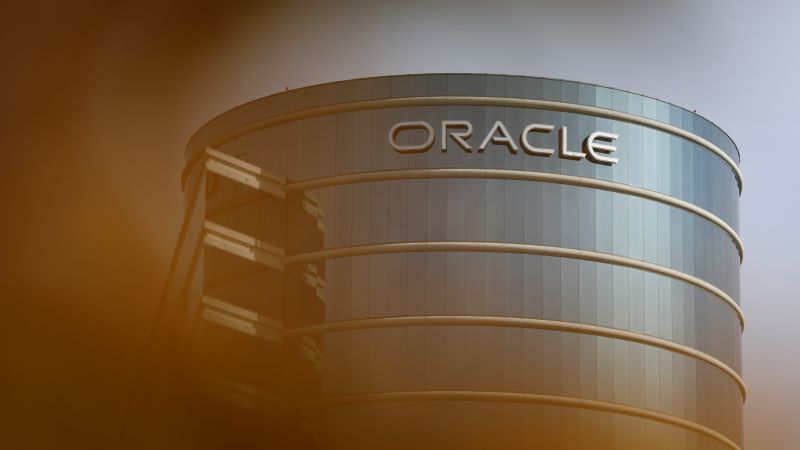
In a dramatic turn of events on Wall Street, Oracle, typically seen as a steady presence in the cloud-computing sector, experienced an astonishing stock surge of over 40% in just one morning. This extraordinary increase marks Oracle’s largest single-day jump ever, propelling co-founder Larry Ellison’s net worth to a staggering $100 billion within just an hour and briefly positioning him as the world’s richest person, surpassing Elon Musk.
What triggered this dramatic stock movement wasn’t an impressive product launch or an unexpected earnings smile. In fact, Oracle’s quarterly figures published the night before fell short of Wall Street’s expectations. Instead, it was the company’s optimistic long-term outlook that sent investors into a frenzy, suggesting Oracle could become a dominant player in the burgeoning field of artificial intelligence (AI). However, this optimistic forecast relies heavily on the revenue generated from one significant client—OpenAI, which has yet to turn a profit.
Steve Sosnick, chief strategist at Interactive Brokers, remarked on the exceptional nature of Oracle’s projections, suggesting that such exuberance might be dismissed as unrealistic if it came from a less established firm. Key drivers behind Oracle’s remarkable stock performance can be traced to bold statements made by CEO Safra Catz. She announced that the company anticipates its cloud infrastructure revenue to soar by 77% to $18 billion by the end of May 2026 and could potentially reach $144 billion by 2030.
Additionally, Catz revealed that Oracle has secured four multi-billion-dollar contracts, resulting in $455 billion in “outstanding contract revenue,” a remarkable 359% increase from the prior year. As a provider of database software, Oracle has strategically positioned itself as a key partner for AI companies in search of expansive computing resources. While semiconductor giant Nvidia is frequently dubbed the “picks and shovels” play of the AI frenzy, Oracle is likened to the durable clothing provider, positioned to benefit from the growth without directly creating the AI itself.
Despite this encouraging narrative, grave concerns surround the sustainability of Oracle’s projections, primarily due to its financial reliance on OpenAI. Reports indicate that OpenAI is facing a monumental cash burn projected to hit $115 billion by 2029, significantly higher than previously assumed. As other technology giants funnel vast sums into data centers to support an anticipated surge in AI demand, the substantial capital investments have now surpassed consumer spending as a primary GDP growth driver in the U.S.
Peter Boockvar, chief investment officer at One Point BFG Wealth Partners, acknowledged the potential impact of this massive data center construction on the economy but echoed caution regarding Oracle’s ambitious stock gains, drawing parallels to the dot-com bubble of 1999, which culminated in a crash. He noted that Oracle’s capital expenditures are unprecedented for a corporation of its size, with an astonishing 52% of its revenue allocated toward such expenditures this fiscal year, compared to 13% in 2024.
This brings to light the profound risks involved, particularly if OpenAI does not deliver on its anticipated performance. As generative AI technology continues to seep into everyday life, public perception has begun to shift, with many expressing skepticism towards its efficacy. The challenge remains for tech operators like OpenAI to produce a significantly innovative update that can either reduce costs or enhance profitability. Failure to meet these expectations poses systemic risks not just for Oracle, but for the entire tech sector.
If Oracle can successfully navigate these challenges, it could justify the exuberance reflected in the market rally. However, as warned by adverse market conditions and the reliance on ambitious guidance, both Oracle’s investors and the broader market must proceed with caution. The stakes are high, and the outlook remains uncertain.