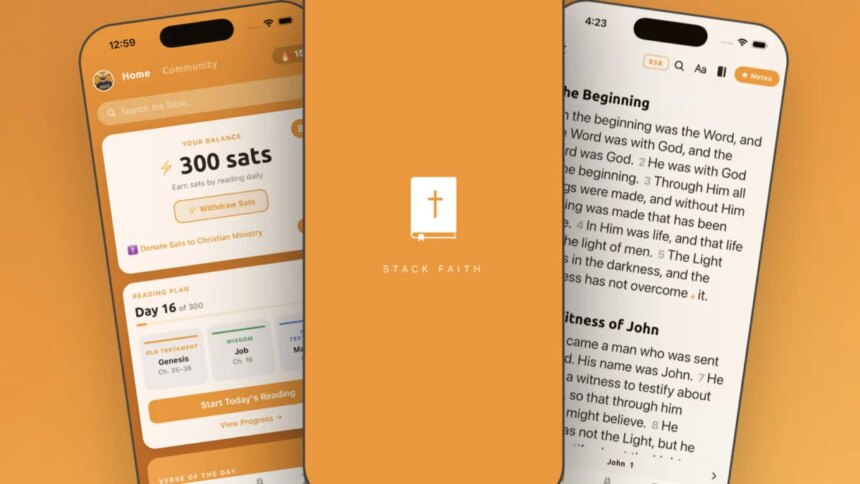
At first glance, the Orange Bible appears to be just another scripture app, but it represents a unique intersection of religious devotion and cryptocurrency advocacy. It is designed not only for followers of Jesus Christ but also for those who resonate with the principles established by Satoshi Nakamoto, the enigmatic creator of Bitcoin. The app encapsulates the growing trend of gamification within the app economy, merging spiritual practice with financial incentives.
The Orange Bible is currently available on iOS, with plans for an Android version on the horizon. It utilizes the public-domain Berean Standard Bible and the King James Version, incorporating popular features commonly found in modern Bible apps. These include options for search, highlighting, note-taking, reading plans, a prayer journal, and device synchronization. However, what truly sets this app apart is its financial component. Users can initiate a reading plan and collect satoshis—the smallest unit of Bitcoin—by maintaining a daily reading habit. Users’ rewards can grow as they unlock higher tiers through consistent engagement.
Alin Armstrong, the creator of the app, emphasized that the distinctive aspect of Orange Bible lies in its reward structure. Unlike traditional app features that provide badges or digital streaks, users earn actual Bitcoin. The app is free to use, but a premium subscription priced at $8.99 per month offers enhanced rewards, including triple Bitcoin incentives for reading sessions. Premium subscribers also gain access to an AI-driven “Bible Study Assistant,” an extensive “Orange Study Bible” featuring over 200 study notes related to biblical economics, and book introductions that explore the economic implications of each Bible book.
Armstrong’s vision for Orange Bible emerges from a pre-existing niche where Christianity and Bitcoin intersect. He revealed that upon entering the Bitcoin community in 2020, he was taken aback by the vibrant network of Christian Bitcoin advocates. His self-published book, which has sold over 10,000 copies in three years, bolstered his belief in this crossover between faith and finance. Armstrong asserts that Bitcoin not only attracts those interested in cryptocurrency but also leads many to explore faith, citing the currency’s immutable and transparent nature as a reflection of objective truth in a world filled with uncertainty.
He articulates a connection between scriptural principles and the foundational tenets of Bitcoin. Armstrong asserts that the guidelines established in the Bible regarding money and fairness correlate directly with the cryptocurrency’s design. He provocatively refers to Bitcoin as a “truth machine,” claiming that all truth ultimately belongs to God. This perspective illustrates that Orange Bible serves a dual purpose: it encourages users to maintain a Bible-reading streak while reinforcing Armstrong’s broader narrative about Bitcoin as a vehicle for “sound money.”
Within the context of an increasingly gamified landscape, Orange Bible feels like a natural evolution of applications that reward user behavior. Crypto incentives have been applied across various domains, from fitness to lifestyle choices, suggesting that even spiritual practices can be gamified. Notably, Armstrong opts for Bitcoin micropayments instead of creating a proprietary token, a common pitfall in the crypto space. He also avoids employing gambling mechanics, which some might view as contrary to Christian values.
Armstrong clarifies that while Bitcoin plays a central role in the app, it is ultimately a tool for advancing a mission that the Church has largely overlooked. Users are also given the option to direct their earned Bitcoin rewards to partnered ministries, effectively transforming the reading-and-earning process into a charitable outreach mechanism. Despite its face value as a devotional app, Orange Bible reflects a broader trend towards software that quantifies and monetizes daily routines, raising questions about the commodification of sacred practices.