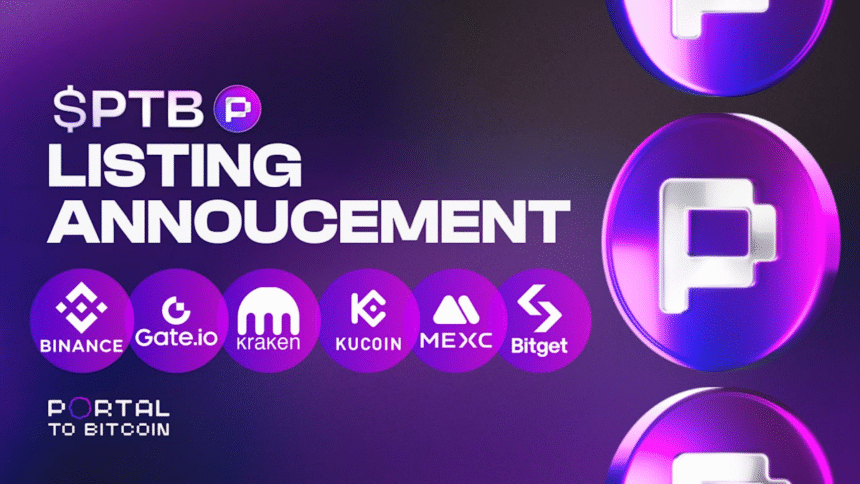
Portal to Bitcoin (PORTAL) has made significant strides in the cryptocurrency arena, recently announcing that its native token, $PTB, will be listed on several major exchanges, including Binance Alpha & Futures, Kraken, KuCoin, Gate.io, Bitget, and MEXC. This development is expected to greatly enhance the accessibility and liquidity of $PTB for users around the world.
The growth trajectory of Portal has been impressive, characterized by a surge in user engagement and network participation over recent months. On its testnet, the platform has successfully processed 18 million transactions and garnered over 1.3 million downloads from the Chrome Web Store, contributing to the creation of 850,000 wallets. Notably, it boasts a retention rate of 73%, with more than 950,000 active wallets still in operation, underscoring the platform’s relevance to a burgeoning global audience.
Financial backing has played a crucial role in Portal’s expansion, securing $92 million in funding from top-tier investors, including Coinbase Ventures, OKX Ventures, and Arrington Capital. Additionally, Portal has launched a $50 million ecosystem fund backed by Paloma Investments, specifically aimed at fostering developer adoption, ecosystem growth, and institutional acceptance. This initiative is designed to position Bitcoin as the primary settlement layer not only for decentralized finance (DeFi) but for traditional finance (TradFi) as well.
Dr. Chandra Duggirala, the CEO and Founder of Portal to Bitcoin, highlighted the pivotal role of their proprietary scaling technology, BitScaler, which enhances Bitcoin’s transaction capabilities beyond existing solutions like the Lightning Network without necessitating alterations to the core Bitcoin protocol. This innovative approach reduces transaction fees and eliminates the need for bridges, Layer 2 solutions, sidechains, or wrapped derivatives.
The $PTB token is strategically designed to promote long-term growth and to reward participants within the ecosystem. Every swap on the platform incurs a 0.3% fee, with half of that fee being reinvested into burning $PTB tokens, thus creating a deflationary effect as demand for the token increases. The ecosystem encourages a well-aligned incentive structure where liquidity providers receive a majority of emissions, while validators and lite nodes are compensated for maintaining network security. Community members are also rewarded through airdrops, initially during the token generation event and subsequently over time, with significant portions of development and reserves being tied to long-term lock-ups.
Dr. Duggirala remarked on the advantages of Portal’s token design, emphasizing that all contributors, from liquidity providers to validators, stand to gain both immediate and long-term rewards from their involvement in the network. The built-in burn mechanism adds sustainability and utility, contributing to overall network expansion and value retention.
Beyond just facilitating swaps, Portal’s ecosystem includes a multi-currency wallet that ensures self-custody and incorporates a cross-chain decentralized exchange (DEX). Their Swap SDK enables easy integration for third-party wallets and DEXs, while the project also offers an AI-driven investment copilot, RAFA-AI, designed to assist professional traders in strategy and decision-making.
With a strong founding team comprised of notable figures in blockchain and technology, such as Dr. Chandra Duggirala—who is credited with inventing BTC Layer 2 cross-chain atomic swaps—Portal to Bitcoin is positioned to significantly influence the next evolution of Bitcoin as a foundational element of global finance. The project is supported by a mix of extensive funding and real-world adoption metrics, marking its ascent in the cryptocurrency landscape.