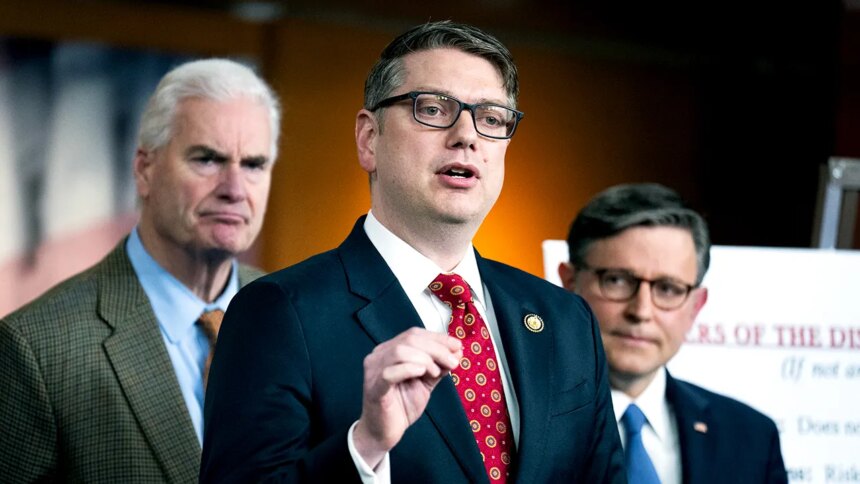
Republicans are pushing for the establishment of a national bitcoin reserve, driven by a proposed legislative initiative that aims to leverage seized digital assets linked to Iranian activities. Representative Nick Begich from Alaska is spearheading the American Reserve Modernization Act, which aims to diversify the United States’ financial reserves by creating a strategic bitcoin reserve managed under the Treasury Department. This reserve would include a dedicated stockpile of federally held digital assets, distinct from traditional cryptocurrencies like bitcoin.
Begich’s proposal is gaining traction across party lines, as he sees bitcoin as a potential counterpart to gold, a long-standing dominant asset in financial reserves. “When you look at gold, it is the dominant precious metal reserve,” he explained. “Similarly, bitcoin constitutes about 60% of the total market capitalization in the crypto space, indicating its position as a leading store of value within this asset class.”
The groundwork for this initiative has been laid since March 2025, when former President Donald Trump signed an executive order aimed at establishing a strategic bitcoin reserve. Although the reserve is not fully operational yet, the Trump administration’s efforts were intended to position the U.S. as a global leader in cryptocurrency. Trump has previously voiced optimism about the transformative potential of cryptocurrency, calling it one of the most significant advancements in financial technology since the internet’s inception.
This recent push comes against the backdrop of Operation Economic Fury, an initiative launched by the Treasury Department to disrupt revenue streams for the Iranian regime. As part of these efforts, the U.S. has seized nearly $500 million in cryptocurrency assets linked to Iran. Representative Pat Harrigan from North Carolina, a co-sponsor of the proposed act, emphasized the need for a clear strategy to manage the significant amounts of seized bitcoin currently held by the government. “The United States government already holds billions in seized bitcoin with no coherent strategy for managing it, and that needs to change,” Harrigan stated.
In a related legislative context, the Senate Banking Committee recently passed the Clarity Act with bipartisan support, which is now headed to the Senate floor for further consideration. Senator Cynthia Lummis from Wyoming, involved in these discussions, mentioned that while there is hope for a vote by mid-June, this timeline may be optimistic.
Begich’s vision is for the U.S. to hold approximately 5% of the global bitcoin supply—around 1 million coins—mirroring the current amount held by the government in gold reserves. This ambition underscores the growing recognition of the importance of digital assets in the global financial landscape.