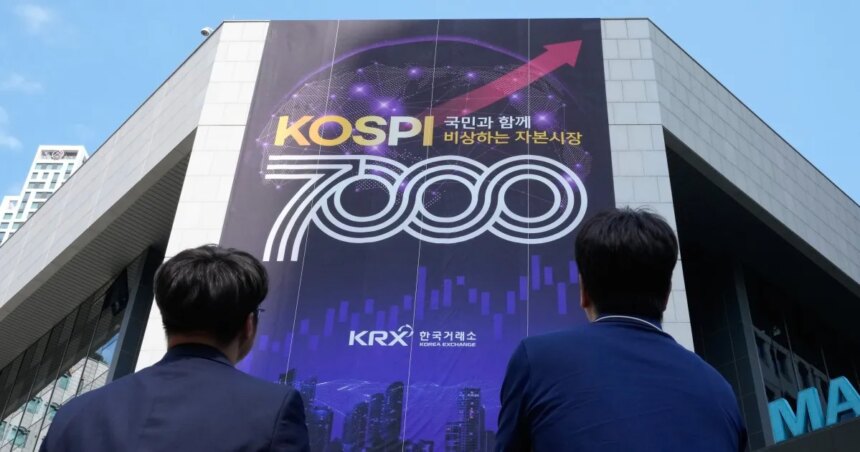
Seoul, South Korea – In a significant shift, many South Koreans are diving into the stock market, drawn by a remarkable rally that has transformed perceptions of investing in the country. Kim Ha-young, a Seoul office worker in her 30s, is one among a growing number of everyday investors who took the plunge into equities for the first time following an unexpected windfall from her apartment deposit.
With minimal market knowledge, Kim chose to invest in SK Hynix and Samsung Electronics, major players in the memory chip sector that underpins the booming AI industry. “I mean, when you think of Korea, you think of Samsung, right?” she remarked, revealing her impulsive decision to invest without extensive research. By September, her stock investments began to flourish, initially yielding hopes of modest gains before rapidly climbing in value. When her shares doubled, Kim opted to hold onto them, reflecting a broader trend of South Koreans engaging more deeply with the stock market.
The interest in stocks has surged dramatically, with ownership rising from about 6 million in 2019 to over 14.5 million by the end of 2025. The benchmark Kospi index has nearly doubled during this period, becoming the world’s best-performing major stock market. Recent data indicates that the number of active stock trading accounts has also swelled to 105.22 million, a significant increase in a short span.
Historically, South Korea’s stock market has been seen as a laggard compared to global counterparts, often marked by low valuations and what’s referred to as the “Korea discount.” Market analysts have long attributed this to weak corporate governance and inadequate shareholder returns in the family-run chaebol system. Consequently, small investors have often been sidelined, fostering a short-term trading culture characterized by volatility.
President Lee Jae Myung’s administration has made efforts to reshape this narrative. During his presidential campaign, Lee promised to lift the Kospi to 5,000 points, which it achieved in January, and has since exceeded. His government has initiated various reforms aimed at empowering minority shareholders, including allowing them to concentrate their voting power in board elections. By encouraging everyday citizens to invest, Lee aims to reduce South Korea’s historical reliance on real estate, which has contributed to an exorbitantly high property market.
Several factors contribute to South Korea’s soaring stock market, not least the global shortage of memory chips due to an upsurge in demand sparked by AI advancements. Companies like Samsung Electronics and SK Hynix are enjoying record profits, elevating them to a market capitalisation of over $1 trillion.
Yet the rally is not without its challenges. Recent market volatility has raised eyebrows, with the Kospi experiencing significant one-day drops, including a nearly 9 percent plunge that prompted a circuit breaker. Experts warn that many profitable companies remain undervalued, and reliance on a few tech giants, such as Microsoft and Apple, to sustain demand poses a risk.
Amid this backdrop, investors like Kim Ha-young aim to take a measured approach to their investments. “I think the best thing is to invest in good companies for the long term,” she advised, underscoring a desire to balance growth with caution. As South Korea’s stock market continues to evolve, the blend of excitement and trepidation among new investors highlights a dynamic shift in the nation’s economic landscape.