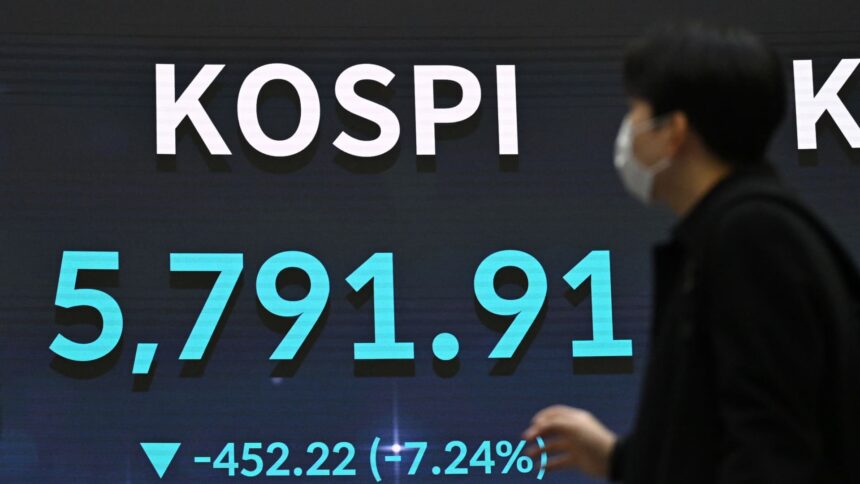
South Korea’s stock market has experienced an unprecedented decline, particularly following military strikes by the U.S. and Israel on Iran. The benchmark Kospi Index registered a staggering drop of more than 12% in a single day, marking it as the worst trading performance in its history. The turmoil has been acute, with the Kospi seeing a total plunge of over 18% this week—its most significant weekly loss since the financial crisis of 2008.
The downturn began on Tuesday, following a national holiday that saw the market closed on Monday. As trading resumed, investors reacted sharply to escalating tensions in the Middle East, which have profound implications for South Korea, given that it relies heavily on imported fossil fuels, predominantly from the region. Reports indicate that approximately 70% of South Korea’s oil imports and up to 30% of its liquefied natural gas come from the Middle East.
The severity of the drop is compounded by the concentration of the Korean stock market. Over a third of the Kospi is dominated by just two companies: Samsung Electronics and SK Hynix. In contrast, the two largest stocks in the U.S. S&P 500—Nvidia and Apple—make up only 14% of that index. Despite a remarkable year for these tech giants, which saw Samsung and SK Hynix investments soar by 216% and 356% respectively, their recent declines have contributed significantly to the market’s instability.
On Wednesday, both companies suffered losses exceeding 10%, leading to temporary trading suspensions on the Korea Exchange. Analysts have described the sharp correction as indicative of a bubble burst, emphasizing that the rapid capital gains over the past year were unsustainable. Such dramatic movements in the market raise concerns about the potential for further declines, especially given the lack of diversity within the index.
In contrast, the U.S. market remains comparatively resilient. Market experts argue that the robust diversification of the U.S. stock market, combined with mechanisms like circuit breakers at the NYSE and Nasdaq, cushion against similar volatile declines. Jay Woods, chief market strategist at Freedom Capital Markets, remarked that while a 12% drop would herald a market catastrophe in the U.S., Korea’s broad sell-off appears to be driven by profit-taking among investors.
Despite its recent turmoil, the Kospi has recorded a performance increased by 20% in 2026 alone, and it has doubled in value over the past year. This context amplifies the magnitude of its current downturn, which some analysts attribute to behavior typical of a bear market. Reports indicate that Korean stocks entered a bear phase within just three days, a rapid shift that underscores the market’s volatility.
Additionally, the role of retail investors cannot be overlooked. The iShares MSCI South Korea ETF, once favored among small investors, is now witnessing a mass exodus. Recent data highlighted a record net outflow of $266 million from retail investors, far surpassing previous highs.
The combination of geopolitical tensions, high investor concentration in a few stocks, and the rising influence of retail investors all contribute to the current precarious state of South Korea’s financial landscape, leaving many to question the market’s next moves in an unpredictable global environment.