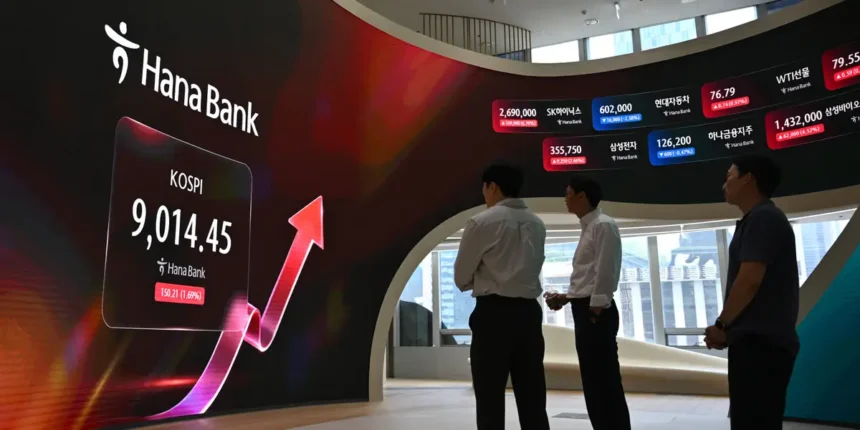
South Korea’s benchmark Kospi index experienced a significant rise of over 5% during early trading on Thursday, marking a continuation of the market’s recovery following a tumultuous tech-driven selloff earlier in the week. The surge was primarily propelled by influential semiconductor companies Samsung Electronics and SK Hynix, as investors began to show renewed confidence in these previously battered stocks after two days of heightened volatility.
Shares of Samsung Electronics saw an increase of more than 6%, while SK Hynix rose nearly 10%. This positive momentum followed news that SK Hynix is moving forward with plans for a major Nasdaq listing that could potentially raise approximately 45.45 trillion won, equivalent to around $29.4 billion. The market sentiment was further boosted by favorable results from memory-chip maker Micron, which reported revenues that exceeded Wall Street’s expectations and provided an optimistic outlook for future performance, particularly in relation to artificial intelligence-related demand.
Thursday’s upward movement in the Kospi index followed a 3.3% recovery on Wednesday, after the benchmark had plummeted nearly 10% on Tuesday—its steepest single-day drop in months. This earlier selloff had ramifications beyond South Korea, affecting global markets and leading to declines in US semiconductor stocks as investors reassessed the high valuations associated with the AI sector, prompting them to shift their focus toward safer investments.
Despite these recent fluctuations, South Korea’s stock market has emerged as one of the strongest performers globally this year, largely driven by gains in semiconductor and AI-related shares. However, the rapid ascent has rendered the market more sensitive to dramatic pullbacks. Analysts remain optimistic about the long-term demand for AI-related chips, interpreting the recent volatility as a necessary correction after a substantial rally, rather than a signal for a downturn in the sector.
Euntaek Lee, an analyst at KB Securities, characterized the earlier pullback as a “cooldown phase during a bull run” rather than an indication of a genuine market downturn. Nevertheless, he cautioned that the market might continue to experience volatility, as it remains vulnerable to more corrections following its extended performance. Lee emphasized that current market conditions do not suggest the presence of a bubble, maintaining a constructive outlook for the future.