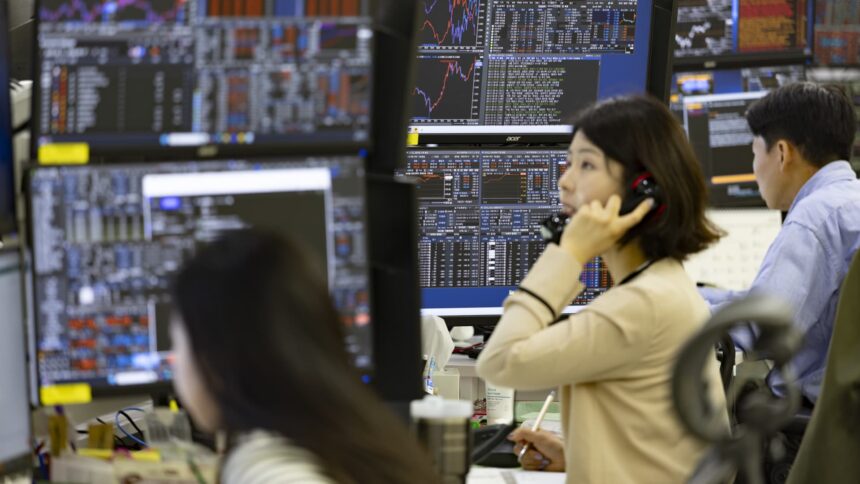
In a significant turn of events for South Korea’s financial landscape, the country’s stock market, notably represented by the Kospi index, has witnessed an impressive surge, doubling its value within the year. Analysts and strategists are optimistic, believing that the rally has potential for further growth, driven primarily by the flourishing artificial intelligence (AI)-linked semiconductor sector.
Goldman Sachs recently announced its revised 12-month target for the benchmark Kospi, now setting it at 12,000 points, which suggests an anticipated upside of over 35% from current levels. According to strategists led by Timothy Moe, this bullish outlook is fueled by earnings growth, which they cite as the main engine propelling Asian equity returns. Their stance remains overweight on the Korean market, anticipating a continuation of higher earnings along with favorable trends in the memory-chip sector.
To date, the Kospi has soared approximately 100% year-to-date, positioning it as one of the best-performing major stock indexes globally. However, this dramatic rise has been largely concentrated among a select number of technology giants. Notably, heavyweights like SK Hynix, a leading memory-chip manufacturer, and electronics powerhouse Samsung Electronics have been instrumental in driving the index’s growth.
Despite this optimistic performance, there are cautionary notes from global financial services firm BTIG. They highlight the risks accompanying the rapid market ascent, with chief technical analyst Jonathan Krinsky pointing out that while the Kospi climbed 12.15% over the last six sessions, market breadth was negative each day. This situation underscores concerns about reliance on a narrow group of large companies, which collectively account for about 50% of the index’s value.
Adding to the complexity, Peter Kim, a global strategist at KB Financial Group, noted that Korea’s semiconductor sector, often referred to as the “twin towers” of the market, is significantly outperforming the overall economy. He cautioned that the rising stock market may be overshadowing underlying vulnerabilities, such as increased competition from Chinese exporters, sluggish wage growth, and weak job creation within the domestic economy.
This divergence between a booming stock market and the softer conditions prevalent in the broader economy poses challenges for policymakers. South Korea is grappling with stagnant wage growth, weak employment rates, and pressures from rising energy costs, even as equity and property valuations continue to ascend.
Nevertheless, global investors seem to be adopting a wait-and-see approach, focusing on the strong AI-driven earnings that characterize the current investment narrative in the region. Goldman Sachs projects that earnings-per-share growth for Asia Pacific equities could reach 60% in 2026, with technology firms expected to lead the charge.
As the market evolves, stakeholders and analysts will be closely monitoring how these dynamics unfold in the coming months.