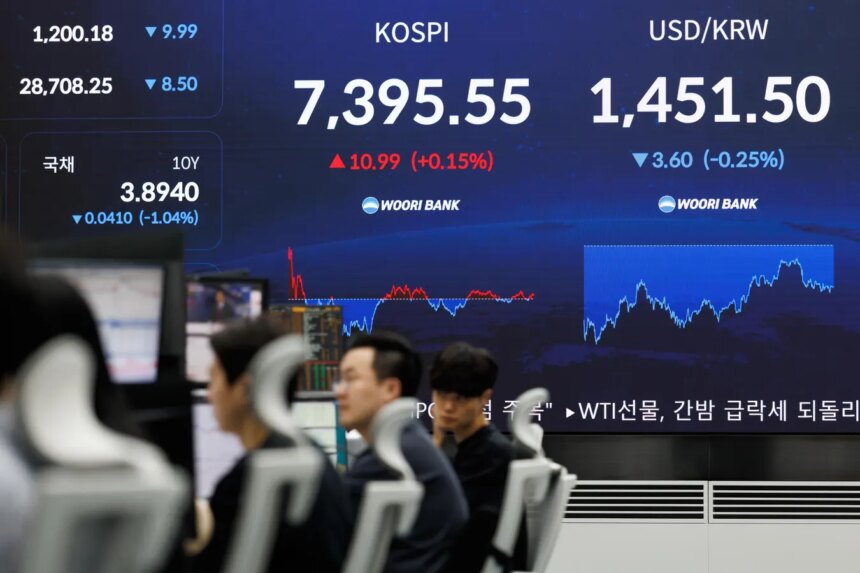
The South Korean financial landscape is experiencing unprecedented volatility, reminiscent of the turbulent market conditions seen during the 1997 financial crisis. Recently, the Korea Composite Stock Price Index, known as the Kospi, displayed remarkable resilience, surging 5% in a single day amid swirling optimism surrounding the artificial intelligence sector. Since the start of 2026, the benchmark index has skyrocketed by an astonishing 90%, signaling robust investor confidence.
The surge is particularly palpable among major players in the semiconductor industry. SK Hynix has emerged as a standout in this volatile market, recently crossing the $1 trillion market capitalization threshold, making it the third company to achieve this milestone. During a single trading session, shares of SK Hynix soared by as much as 13%, contributing to a year-to-date gain exceeding 1,000%. The unpredictable nature of these stocks has led to comparisons with meme stocks and cryptocurrencies, with their prices oscillating dramatically as investor sentiments shift.
Despite the exhilarating market performance, experts caution that such volatility poses significant risks to South Korea’s $1.9 trillion economy. The economy has increasingly adopted a leveraged approach, heavily reliant on artificial intelligence for growth. This reliance comes in the wake of a robust first quarter, where exports saw a year-on-year increase of approximately 40%, despite challenges such as weak domestic demand and rising inflation. The initial days of May further illustrated this trend, with exports climbing nearly 65%, propelled primarily by a staggering 305% rise in computing equipment and remarkable gains in the semiconductor sector.
The government, led by President Lee Jae Myung, views artificial intelligence as a silver bullet capable of addressing longstanding economic issues, including productivity challenges and inequality. However, the focus on AI, primarily funneled through long-established family-owned conglomerates known as chaebols, raises concerns about consolidating economic power rather than diminishing it.
Additionally, the Democratic Party is contemplating the use of profits generated from the AI boom to fund a “people’s dividend,” which critics argue may serve more as a temporary fix than a substantive strategy to enhance economic opportunities across the spectrum.
Korea’s market dynamics are increasingly drawing comparisons to other Asian economies, notably Taiwan, which recently overtook India to become the fifth-largest stock market globally, despite its relatively small population. The juxtaposition of South Korea’s declining automobile exports—down by 10%—with its soaring stock index underscores a significant shift in economic priorities and perceptions.
As the Kospi index rides the wave of speculative enthusiasm, some analysts liken its performance to the dot-com era of the late 1990s, raising questions about the sustainability of this remarkable growth. As major stock exchanges begin to mimic the erratic behavior of cryptocurrency markets, experts warn that South Korea may find itself grappling with economic repercussions if this AI-driven boom fails to maintain momentum.