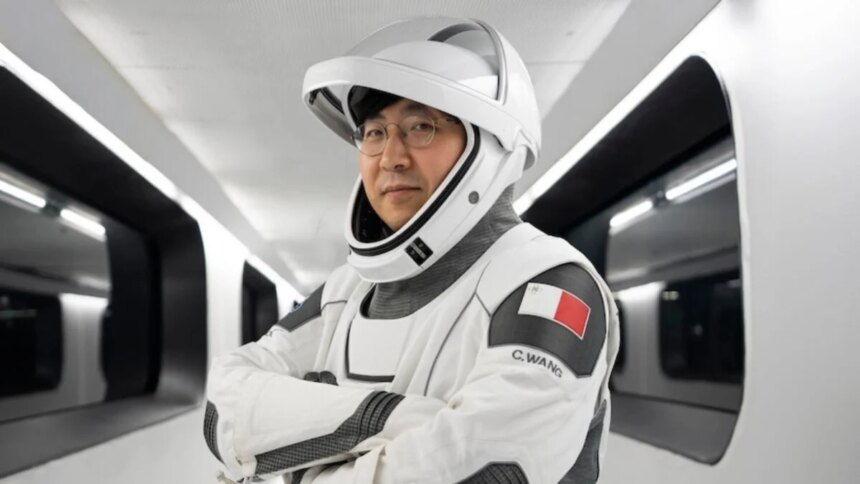
SpaceX’s recent attempt to launch its Starship V3 faced setbacks, but the company utilized the countdown to share captivating news about its future interplanetary mission. Just minutes before the anticipated lift-off, SpaceX introduced Chun Wang, the civilian astronaut set to lead the company’s first crewed voyage to Mars. In a live webcast, Wang addressed viewers from Bouvet Island, a remote location in the South Atlantic Ocean, detailing his aspirations for the upcoming mission, which will involve a flyby of both the Moon and Mars.
Wang, a notable figure in the cryptocurrency industry, co-founded F2Pool, among the earliest Bitcoin mining pools in China. After accumulating substantial wealth from his cryptocurrency ventures, he now identifies as a “full-time traveler” and has shown a growing interest in commercial spaceflights. Previously, he commanded SpaceX’s Fram2 mission – a significant milestone, as he self-funded the trip that included three other first-time civilian astronauts on a three-day expedition around Earth’s poles aboard a SpaceX Crew Dragon spacecraft.
The Mars mission represents a monumental leap for Wang and SpaceX alike, with estimates suggesting a round trip could take around two years. During an interview with SpaceX Communications Manager Huot, Wang expressed eagerness but not concern regarding the extended journey—demonstrating confidence in his ability to appreciate the experience. “I can stare at the map view on airplanes all the way from takeoff through landing, so I think I’m going to enjoy the trip,” he remarked, despite the fact that significant development lies ahead for Starship V3.
The attempt to launch Starship V3 encountered an unexpected halt due to mechanical complications with the launch tower, prompting a new launch attempt aimed for the following day. This iteration of SpaceX’s super heavy-lift launch vehicle is unique, being the largest and most powerful rocket ever constructed. Its successful operation is vital not only for SpaceX but also for NASA’s missions, which had initially relied on a modified version of Starship for lunar exploration. Due to ongoing developmental delays, NASA is now also exploring alternatives, including a lunar lander developed by Blue Origin.
Elon Musk addressed the delays by reassuring that a pipeline of V3 ships and boosters is in place. The setback was attributed to almost complete redesigns of the rocket’s core systems. Musk noted that any failures in scheduled launches would not significantly impact the overall timeline, stating, “Failure today will not affect schedule by more than a month or so.”
As anticipation builds for Starship V3’s maiden launch, experts have recognized the stakes involved. Eric Berger, a senior editor at Ars Technica, emphasized the critical nature of the launch for NASA. With ongoing developmental delays possibly favoring other companies like Blue Origin, the pressure is mounting for SpaceX.
While SpaceX engineers work to resolve the mechanical issues encountered, the broader uncertainty remains. Should the V3 experience a series of failures similar to its predecessor, Wang and his aspiration for a mission to Mars may be further delayed. The excitement surrounding SpaceX’s ambitions continues to grow, as both the company and its spacefaring customers keep an eye to the skies.