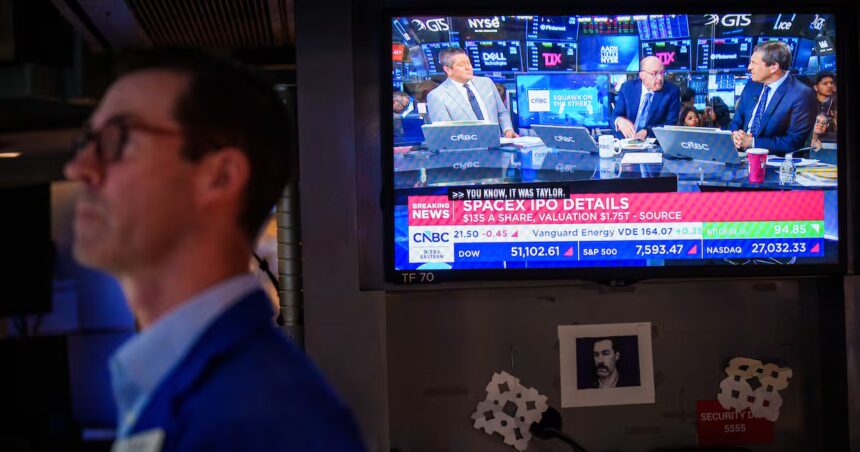
As the highly anticipated initial public offering (IPO) of Elon Musk’s SpaceX approaches, the financial world is buzzing with a mix of excitement and apprehension. SpaceX is seeking to raise a staggering $75 billion through the listing, which would place its estimated valuation at around $1.77 trillion, marking what could be the largest flotation in history. This monumental IPO has the potential to make Musk the first dollar trillionaire on the planet, attracting both optimistic and cautious investors eager to participate in this record-setting event.
The fervor surrounding SpaceX is palpable, yet even those who support the investment find themselves pondering the sustainability of such enthusiasm. With the advent of the artificial intelligence (AI) revolution, which presents both opportunities and pitfalls, the excitement is tempered by concern. SpaceX’s listing is just the initial note in a growing symphony of mega-floats. Reports suggest that companies like Anthropic, the creator of Claude, might float in the upcoming months aiming to raise $900 billion, while ChatGPT’s parent company, OpenAI, could potentially achieve a $1 trillion valuation. Other giants including Databricks, Stripe, Shein, and Revolut are also gearing up for an increasingly crowded IPO landscape.
Historically, such vigorous IPO activity can signal the peak of stifling investor bullishness. Many seasoned investors recall the late 1990s dot-com bubble, understanding the precariousness of the current climate. With both SpaceX and OpenAI reporting unprofitability and Anthropic only recently achieving profitability, experts face challenges in accurately determining these companies’ fair values. This uncertainty, combined with the accelerating trend of IPOs, raises alarms. Sanjiv Tumkur from Rathbones cautions that the present surge might suggest a peak in market levels.
Garry White, chief investment commentator at Charles Stanley, expresses astonishment at the scale of these flotations. He predicts that SpaceX, alongside OpenAI and Anthropic, could infuse over $3 trillion in equity value into the U.S. stock market within a short timeframe, making this one of the most significant IPO cycles in financial history. SpaceX distinguishes itself as part of a “new class of late-stage IPO candidates,” waiting until they achieve substantial revenue before approaching public investors.
The advent of accelerated entry systems to Nasdaq allows these new listings to join the Nasdaq 100 almost immediately, inviting potential distortions in market dynamics. This move may compel passive funds to invest in stocks at inflated valuations before proper price evaluations can occur. Analysts predict that this influx of IPOs could draw capital away from established asset classes, leaving underlying markets, including Bitcoin, at risk.
As the current bull market, which has persisted since March 2009, struggles against the backdrop of high valuations, Tom Stevenson of Fidelity International acknowledges the risks involved. Despite nine consecutive weeks of rising stock markets—the most robust rally in three years—he warns that rising price-to-earnings ratios are reminiscent of the dot-com bubble.
Amidst these challenges, inflation looms as a significant concern, as rising oil prices and climbing government bond yields could dampen equity performance. Ashok Bhatia of Neuberger emphasizes the importance of recognizing the potential impact of escalating interest rates, particularly as the 30-year U.S. treasuries reach highs not seen since before the 2007 financial crisis.
As stock markets continue to reach new heights, investor sentiment teeters on the edge of unease. The dual forces of unprecedented IPO activity and the burgeoning AI sector are elevating stakes for global markets. While betting against major technology firms has proven disadvantageous over the years, the current environment, characterized by extreme valuations and concentrated market leadership, poses enough uncertainty to cause even staunch bulls to reconsider their positions. The financial landscape remains volatile, and those investing in this wave of innovation must navigate the complexities with caution.