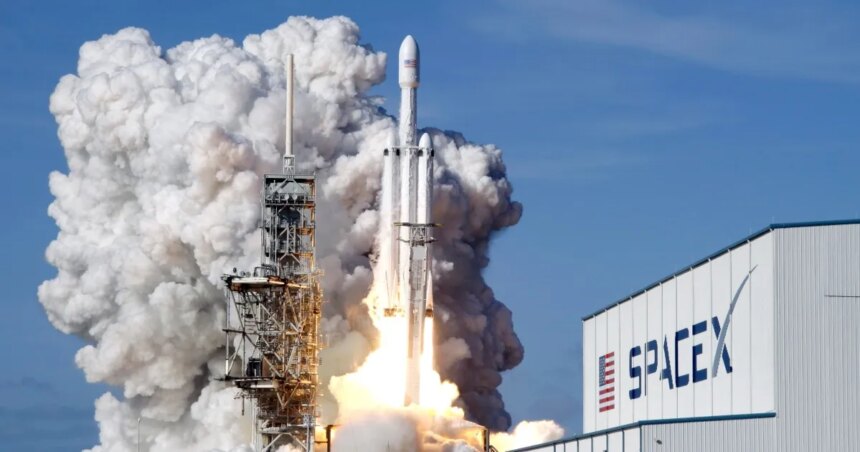
Elon Musk’s space exploration company, SpaceX, is gearing up for a monumental initial public offering (IPO) targeting a valuation of approximately $1.77 trillion. This ambitious move could position SpaceX as the largest stock market debut in history. In a recent filing with the U.S. Securities and Exchange Commission, the company disclosed plans to sell 555.6 million shares at a price of $135 each, aiming to raise around $75 billion.
If the IPO proceeds as planned, this staggering valuation would secure SpaceX’s place as the seventh-largest company globally by market capitalization, putting it ahead of notable competitors such as Musk’s own Tesla and social media leader Meta. The ambitious valuation is also set to surpass Saudi Aramco’s 2019 IPO, which raised $26 billion at a valuation of $1.7 trillion.
Musk, who owns roughly 42 percent of SpaceX, could become the world’s first trillionaire following this public offering, set to list on Nasdaq starting June 12. Despite the transition to a publicly traded entity, Musk will continue to exercise a significant degree of control over SpaceX, maintaining over 82 percent of voting rights through a dual-class stock structure that allows certain shares ten votes instead of one.
The company’s decision to establish a definitive share price prior to the launch of an investor roadshow is a notable deviation from typical IPO preparation protocols, where a preliminary price range is normally announced. Market analyst Fabien Yip commented that this decision reflects Musk’s firm control over the IPO’s terms and demonstrates his confidence in garnering investor interest.
Founded by Musk in 2002, SpaceX is widely recognized for its innovative work in designing and launching rockets, spacecraft, and reusable launch vehicles for NASA and private enterprises. The company also operates in the realms of internet services and artificial intelligence through its Starlink and xAI divisions. Musk’s visionary goals include the establishment of a self-sustaining city on Mars and making life multiplanetary, emphasizing the company’s focus on long-term aspirations.
However, the IPO will be a critical test of investor confidence, particularly in light of SpaceX’s financial performance. The company reported a net loss of $4.9 billion on revenues of $18.7 billion in 2025, followed by a $4.3 billion deficit in the first quarter of the current year. Jay R. Ritter, an expert in IPOs from the University of Florida, highlighted the distinction between SpaceX’s offering and Saudi Aramco’s, noting that the latter is built on a foundation of extensive revenue and profitability, whereas SpaceX is currently not profitable.
Investors are reportedly optimistic despite SpaceX’s financial status, with market sentiment reflecting strong interest in its future potential. Some predictions place the company’s market capitalization at $2.2 trillion by the end of its first trading day. Drawing parallels to Tesla’s IPO in 2010, which also debuted as a loss-making entity and didn’t break away until it turned profitable in 2013, Yip noted that investors are making a similar wager on SpaceX despite its lack of profitability. The added complexity for SpaceX is its broad market addressability in sectors like rockets, satellite internet, and artificial intelligence.
This IPO marks the first in a series of high-profile public listings expected this year, which also include AI startups like OpenAI and Anthropic. Collectively, these offerings have the potential to significantly boost the U.S. stock market, already reaching record highs amid a prevailing AI-driven boom.