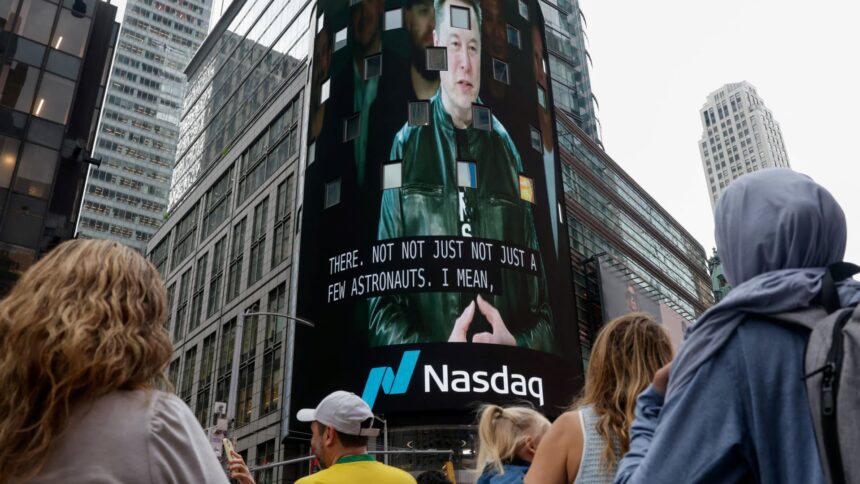
Wall Street experienced a surge of relief on Friday following SpaceX’s highly anticipated initial public offering (IPO), which marked a record-breaking debut in the market. The successful launch of SpaceX’s stock wiped away the anxiety that had accumulated throughout the week regarding the market’s capacity to absorb the largest IPO in history. By the end of the trading day, SpaceX shares closed up 19%, reaching nearly $161 per share, translating to a market valuation exceeding $2.1 trillion and placing it as the sixth-largest publicly traded company in the United States.
The stock debuted at $150, surpassing its initial offering price of $135, and at one point, the share price soared as high as $176 before settling slightly lower. The IPO raised an impressive $75 billion, simultaneously catapulting CEO Elon Musk into the status of the world’s first trillionaire.
Moments before trading commenced, financial commentator Jim Cramer shared positive early indicators of demand for the IPO during a Morning Meeting broadcast, alleviating concerns in the market about whether banks could manage the offering successfully. “We’re over the hump,” he stated confidently, suggesting that the successful IPO had shifted investor sentiment positively. As a result, major stock indices responded favorably, with the S&P 500 rising by 0.5% and closing the week with nearly a 0.7% gain, while the Nasdaq added 0.3% on Friday, also ending the week up by 0.7%.
Several key factors influenced the market last week. Amid apprehensions about the potential impact of the SpaceX IPO on available equity, the influx of cash into the market allowed for strategic maneuvering. In a precautionary measure, Cramer and his team trimmed positions across a few stocks, including Goldman Sachs and Arm Holdings, raising their cash reserves to a considerable 12%. This move aimed at preparing for any potential downturn or volatility resulting from SpaceX’s entry into the market.
In addition, recent developments in the technology sector played a significant role. Corning announced a lucrative contract with Amazon for its optical fiber technology, bolstering its optical communications division. The agreement signifies a shift from copper to optical solutions for data center development and is part of a series of partnerships Corning has formed with major players like Nvidia and Meta Platforms.
On the AI front, Oracle reported robust plans to invest $20 billion in AI infrastructure while simultaneously announcing a rise in quarterly earnings. Despite the positive news, Oracle shares saw a near 9% decline, overshadowed by concerns over the substantial funding raised. However, stocks related to artificial intelligence generally performed strongly, with Intel leading the pack with over a 25% weekly gain, driven by a double upgrade from Bank of America.
Meanwhile, the broader market faced mixed sentiments regarding inflation. Recent consumer price index data revealed a higher-than-expected increase, primarily due to rising oil prices linked to geopolitical tensions in Iran. Cramer maintained an optimistic outlook, suggesting the inflation spike could stabilize once conflicts subsided. Markets anticipate the upcoming Federal Reserve meeting on June 17, where speculations regarding interest rates will be addressed under new leadership.
As traders brace for potential shifts in monetary policy, Wall Street remains vigilant amid rising IPO activity and fluctuating economic indicators.